Integration
Where acquisition value is either extracted or quietly lost.
Platform Clarity supports pre-acquisition IT review, technical due diligence, and post-acquisition integration assessment. The integration question is
not only whether systems can connect. The question is whether they can be integrated in a way that enables rationalisation, cost reduction, and
measurable value outcomes.
Why this lens is often missed
Technical due diligence can confirm that a platform works, yet still miss the conditions required for post-acquisition value extraction.
Integration planning is frequently disconnected from behavioural fit, operating model realities, and dependency depth.
Hidden dependencies
Duplicated capability
Behavioural mismatch
Weak outcome evidence
Positioning statement
Integration Clarity Review: a structured pre and post acquisition lens that tests integration readiness and then guides
rationalisation toward measurable commercial outcomes.
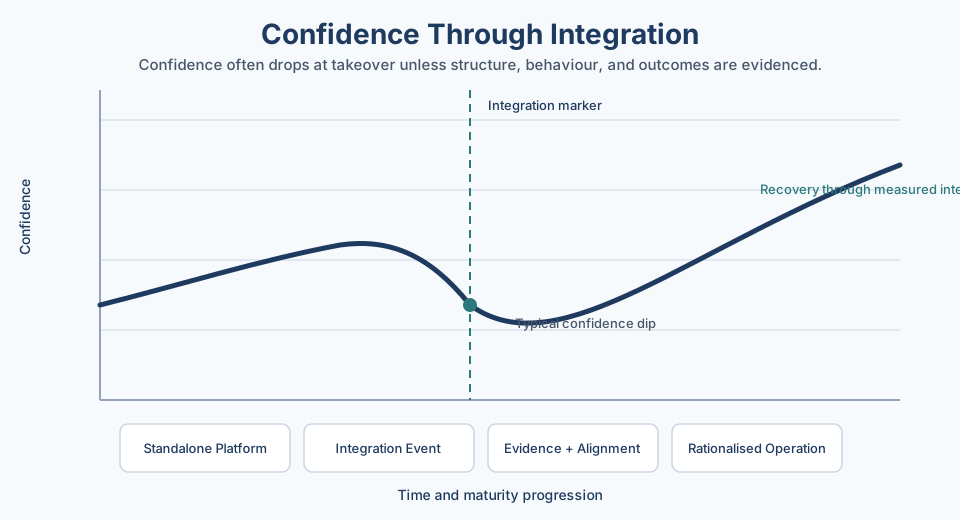
Confidence Through Integration
Service package structure
1. Pre-acquisition integration readiness
- Map architecture fit and dependency exposure against target operating model.
- Identify duplication and likely rationalisation blockers before close.
- Assess observability quality for key journeys and business outcomes.
- Highlight integration risk with confidence levels, not generic red flags.
Typical outputs: readiness map, risk register, integration feasibility notes, first 90-day focus.
2. Post-acquisition integration and value extraction
- Prioritise dependency cuts and service consolidation sequence.
- Validate behavioural alignment for critical personas and journeys.
- Define instrumentation for operational confidence and value tracking.
- Sequence rationalisation actions tied to cost and delivery outcomes.
Typical outputs: integration pathway, rationalisation map, confidence checkpoints, value extraction view.
M&A assistance
Pre-deal support
Support technical and product due diligence with an integration-first lens: what can be integrated, what will resist consolidation, and where
hidden cost sits.
- Integration readiness and dependency exposure
- Duplicated capability and likely rationalisation effort
- Confidence risks that may affect deal assumptions
Post-deal support
Translate acquisition intent into a practical integration pathway that protects continuity while moving toward simplification and measurable
value extraction.
- First 90-day integration priorities
- Behaviour and observability checkpoints
- Rationalisation sequencing tied to cost outcomes
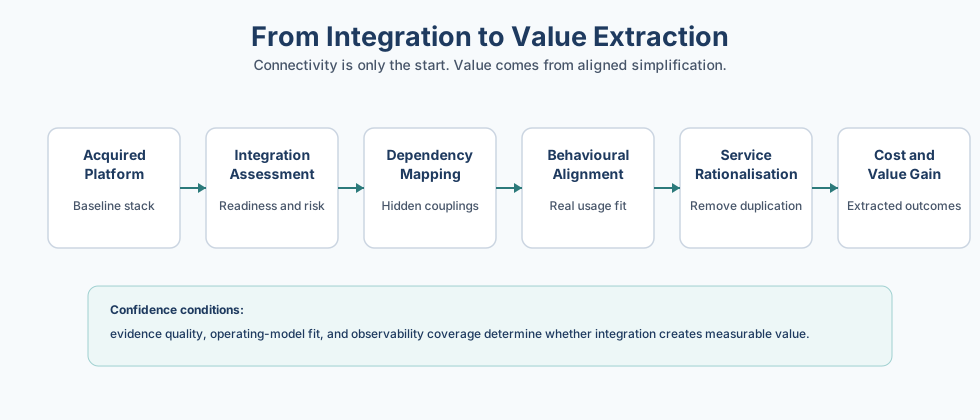
From integration to value extraction
Practical integration checklist
| Review area |
Key question |
Why it matters |
Weak answer usually indicates |
| Architecture fit |
Are boundaries and ownership compatible with the acquiring platform model? |
Determines whether integration can progress without structural rework. |
High migration friction and delayed value extraction. |
| Systems and dependencies |
Which dependencies are critical, hidden, or undocumented? |
Prevents unexpected blockers during cutover and consolidation. |
Late-stage surprises, outages, and schedule slippage. |
| Behavioural alignment |
Do key user journeys still hold after integration assumptions are applied? |
Protects adoption, retention, and operating confidence. |
Journey breakage and value leakage despite technical success. |
| Observability |
Can we measure integration impact on critical journeys and outcomes? |
Supports confident decisions, not inference. |
Disagreement on performance and unclear accountability. |
| Rationalisation |
Which duplicated capabilities can be retired safely and in what order? |
Directly drives cost reduction and simplification. |
Parallel-run sprawl and recurring operational overhead. |
| Cost extraction |
How quickly can cost and delivery gains be evidenced post-integration? |
Keeps integration tied to commercial intent. |
Lengthy integration programs with weak measurable return. |
Integration readiness maturity model
Standalone only
Platform functions independently but has little readiness for external integration.
Risk: high uncertainty once ownership changes. Next: expose dependency and ownership maps.
Technically connectable
Interfaces exist, but operational assumptions and edge-case handling are unclear.
Risk: connection without confidence. Next: define run-model compatibility and service boundaries.
Operationally alignable
Runbooks and support models can be aligned with manageable effort.
Risk: delivery drag from unresolved ownership. Next: evidence user-journey behaviour across contexts.
Behaviourally understood
Critical persona journeys are visible and integration impacts are measurable.
Risk: metric noise if instrumentation is shallow. Next: identify duplicated capabilities by outcome value.
Rationalisation-ready
Duplication, dependency trade-offs, and retirement sequencing are explicit.
Risk: missed savings if execution sequencing is weak. Next: tie rationalisation to value checkpoints.
Value-extraction capable
Integration choices are linked to measurable cost reduction and improved delivery confidence.
Outcome: integration operates as a value program, not a technical merge.
Why integration is where value is won or lost
Many acquisitions underperform not because systems fail to connect, but because integration is treated as a technical task rather than a value
extraction program. Confidence drops when dependencies, behaviours, and outcomes are not visible.
Platform Clarity provides a structured path from integration uncertainty to rationalised, measurable operation. See
Approach for engagement structure, or return to Home to navigate the full model.
Common M&A IT review questions
What should a pre-acquisition IT review actually answer?
It should answer whether the platform can be integrated into the acquiring organisation with a realistic path to rationalisation, cost control,
and operational confidence. That means looking beyond connectivity into dependencies, ownership, critical journeys, and evidence quality.
Is technical due diligence enough on its own?
Not usually. Technical due diligence can confirm that a platform functions, but still miss the delivery, behavioural, and operating-model issues
that block post-acquisition value extraction. That is why Platform Clarity treats integration as a first-class lens rather than an afterthought.
What does a post-acquisition integration assessment focus on?
The useful questions are usually about sequencing, duplicated capability, hidden cost, journey impact, and whether outcomes can be evidenced as
consolidation starts. The aim is to move from takeover complexity to a practical integration pathway.
When should a business commission an integration review?
The best time is before close if acquisition is active, or immediately after ownership change if decisions on consolidation and operating model
fit need to be made quickly. For the session format, see the 90-minute platform review approach. For the
architecture side, see the architecture review lens.