Can the organisation remain trustworthy under pressure?
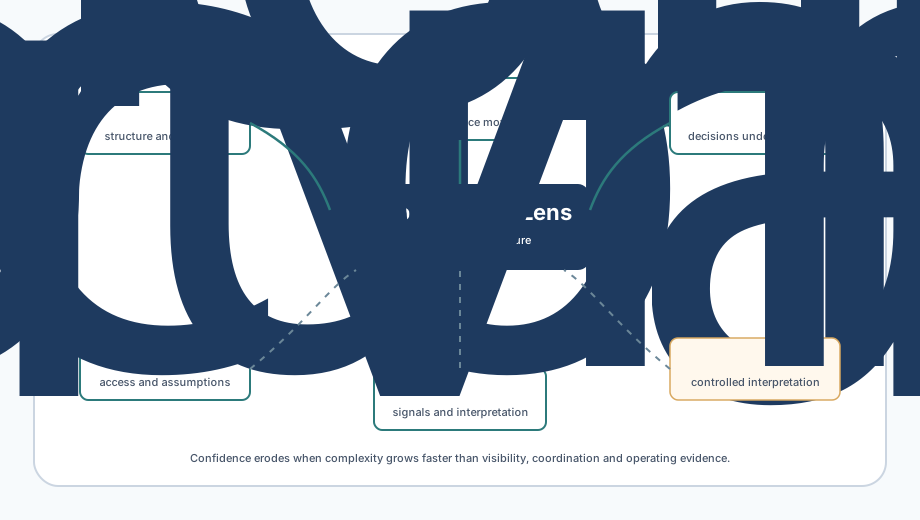
The Lens is a practical way to read architecture, flow, governance, observability, trust boundaries and AI context governance as one operating system.
It is not a proprietary framework. It is a disciplined way of asking whether confidence is earned by evidence or inherited from habit, optimism and dashboards that only show the easy part.
Platform Clarity looks for the places where structure, delivery behaviour, control, evidence and accountability have stopped lining up. Those gaps often appear before failure as friction, exception growth, hidden coupling, confused ownership or weak interpretation of signals.
Practical test
Pressure makes the system honest
Scale, integration, acquisition, incidents, supplier dependency, regulatory scrutiny and AI-enabled automation expose whether governance is operating memory or just meeting rhythm. The Lens asks what survives when the environment changes.
Lens elements
What gets inspected together
Architecture and hidden coupling: where structure creates dependency concentration, reversibility loss or recovery complexity.
Operational flow: how work, evidence, decisions and feedback move through the organisation.
Governance under pressure: whether decision rights, exceptions and controls survive delivery acceleration.
Observability and interpretation: whether signals explain behaviour, impact, ownership and outcomes.
Trust boundaries and blast radius: where assumptions change and verification, segmentation or containment should increase.
AI context governance: how retrieval, tools, models and human decisions are constrained across organisational domains.
Signals & Failure Patterns
A reusable review mechanism.
Platform Clarity separates evidence into observable signals, failure patterns, pressure indicators and confidence erosion indicators. The aim is not to produce a decorative dashboard. The aim is to know where confidence is weakening before the organisation learns it through an incident.
Failure patterns
Governance theatre
Metric gaming
Dashboard confidence without interpretation
Uncontrolled AI context aggregation
Pressure indicators
Approval latency
Exception age
Dependency density
Operational support amplification
Confidence erosion
Visibility collapses before failure appears
Ownership is unclear at boundary crossings
Recovery requires undocumented coordination
AI use expands faster than auditability
Operational physics
Recurring constructs
Coordination load
The amount of cross-team negotiation required to make safe progress.
Confidence lag
The delay between operational reality changing and leaders understanding the consequence.
Dependency density
The concentration of system, supplier, data or team dependencies in a small operating area.
Observability decay
The gradual loss of explanatory power as systems, teams and behaviour change.
Blast-radius concentration
The degree to which one failure, identity, supplier or decision can affect multiple domains.
Context expansion risk
The risk that AI retrieval or orchestration correlates information across domains that used to be separated.
Visual semantics
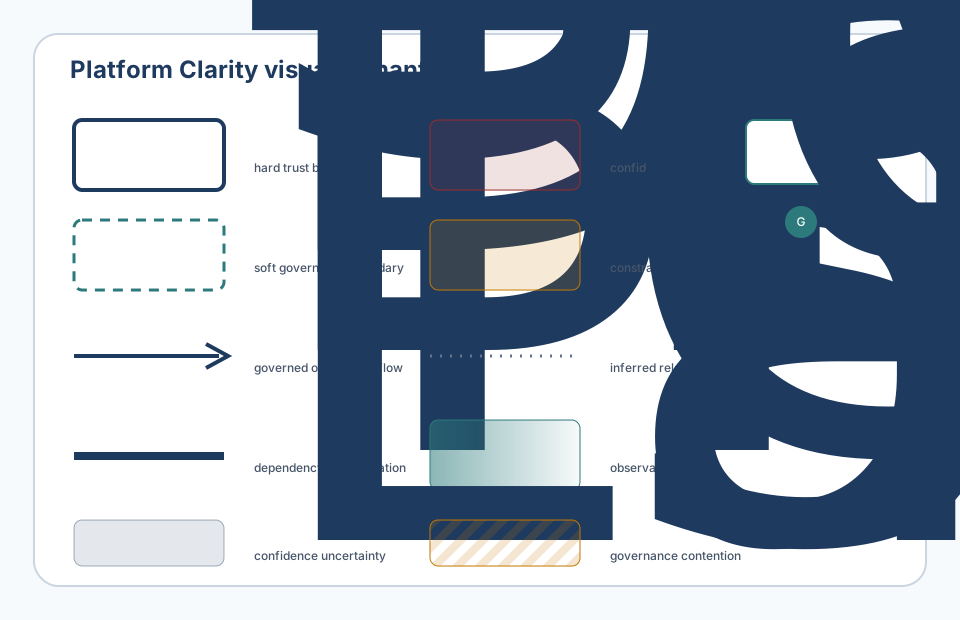
Diagram marks should mean something.
Solid boundary: hard trust boundary.
Dashed boundary: soft governance boundary.
Red overlay: confidence erosion.
Amber overlay: constrained visibility.
Blue flow line: governed operational flow.
Gradient fade: observability decay.
Pressure & change scenarios
Where the Lens is useful
Acquisition integration pressure
Tests integration readiness, duplicated capability, hidden dependencies and value-extraction confidence.
AI-enabled operational expansion
Tests retrieval boundaries, context aggregation, AI observability and governed intelligence pathways.
Governance under acceleration
Tests whether controls improve decisions or create bypass routes when delivery speed increases.
Supplier dependency concentration
Tests operational survivability when a supplier owns critical access, knowledge, support or data movement.
Legacy modernisation under delivery
Tests reversibility, segmentation, release safety and how much undocumented coordination keeps the system alive.
Regulatory pressure event
Tests whether evidence, ownership, risk acceptance and control operation can be reconstructed quickly.
Use the Lens to start a review
The useful first step is not a broad transformation programme. It is a structured read of where confidence is earned, where it is assumed, and where pressure would expose the difference.