
Security governance
ISO 27001
ISO 27001 as an organisational risk governance system rather than a checklist of technical security controls.
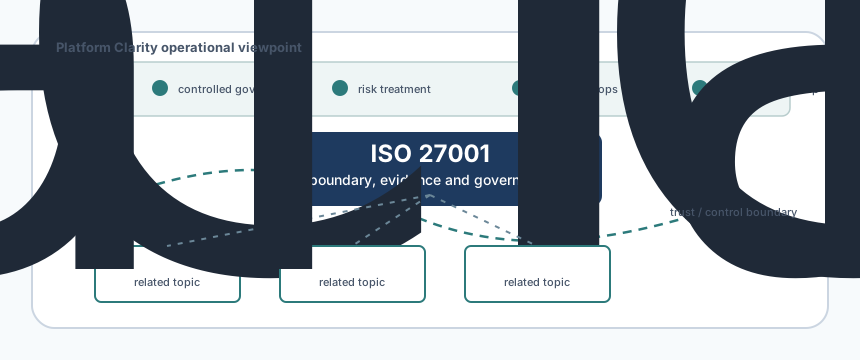
Platform Clarity perspective
The operational reading
ISO 27001 is strongest when it keeps risk decisions connected to operational evidence. It is weakest when certification becomes more important than whether controls survive delivery pressure.
Related operational concepts
- controlled governance
- risk treatment
- evidence loops
- security ownership
- exception discipline
Observable signals
- control exceptions
- risk treatment overdue age
- audit finding recurrence
- access review completion
- supplier assurance gaps
- incident-to-control traceability
When this becomes harmful
- certification drives paper controls
- risk registers detach from delivery
- exceptions become permanent
- evidence appears only before audits
Operational scenario
The organisation has certification evidence, but security exceptions age quietly while delivery teams work around controls. ISO 27001 review connects the ISMS to live risk treatment, supplier access, incident learning and operational ownership.
AI governance thread
AI changes the risk surface for access, suppliers, data use and monitoring; the ISMS needs to absorb those changes without becoming a separate AI paperwork exercise.
Signals & failure patterns
What to look for before confidence becomes fragile.
These are not scorecards by themselves. They are review prompts: signs that flow, trust, governance or operational understanding may be degrading under pressure.
Failure patterns
- paper controls
- audit-centric governance
- detached risk registers
- permanent exceptions
Pressure indicators
- risk treatment overdue age
- control exceptions
- audit finding recurrence
- supplier assurance gaps
Confidence erosion
- certification evidence looks strong while operational ownership is weak
- controls fail silently under delivery pressure
From theory to operating reality
What changes under pressure
ISO 27001 is valuable when the ISMS stays connected to live risk and operating evidence. It becomes theatre when certification evidence is cleaner than the environment it describes.
Knowledge graph
Read this with the neighbouring disciplines.
Platform Clarity treats each topic as part of an operating model: controls change flow, flow creates evidence, evidence changes governance, and governance must survive delivery pressure.
Visual pattern: ISMS evidence loop showing risk, control, exception, audit finding, owner and corrective action.
Introduction
ISO 27001 is best understood as an information security management system. It is about how an organisation governs security risk, not simply whether it has a set of technical controls.
Why It Exists
Security risk crosses departments, suppliers, systems, people and business processes. ISO 27001 exists to create a managed system for identifying risks, selecting controls, reviewing effectiveness and improving over time.
Historical Context
The standard evolved from earlier information security management practices and became a recognised international certification route. Its staying power comes from treating security as a management discipline rather than a purely technical function.
Core Principles
- Security risk should be identified, assessed, treated and reviewed.
- Controls should be selected because they address risk, not because they look familiar.
- Management commitment matters because security decisions affect budgets, suppliers and operations.
- Improvement should be built into the management system.
Operational Interpretation
In operational terms, ISO 27001 should change how people make decisions. It should influence review questions, design constraints, evidence expectations and escalation paths. If it only appears in policy documents, architecture packs or procurement questionnaires, it has not yet become part of the operating system of the organisation.
Common Misunderstandings
- Treating certification as proof that security is operationally mature.
- Writing policies that do not match how teams work.
- Assuming Annex A controls are the whole of security governance.
Common Failure Modes
- Risk registers become static documents.
- Internal audits check presence of paperwork but not operating reality.
- Suppliers are approved once and not reviewed as services change.
- Incident lessons do not feed back into risk treatment.
Relationship To Other Frameworks
ISO 27001 rarely stands alone. It connects to the surrounding operating model because platforms are made of governance, delivery, security, data, people and evidence. The related topics below should be read as neighbouring disciplines rather than optional extras.
Practical Organisational Examples
- A SaaS provider uses ISO 27001 to align supplier reviews, asset ownership, access reviews and incident response into one management rhythm.
- An acquisition review finds certification but weak evidence that cloud configuration, identity lifecycle and logging are actually governed.
- A growing company creates a simple ISMS before enterprise customers demand assurance, avoiding a rushed certification scramble.
Worked Scenario
A company wins larger customers and is asked for evidence of information security maturity. The rushed response is to produce policies, buy templates and aim for certification as quickly as possible. That may satisfy a procurement question, but it can leave the actual operating risks unchanged.
An ISO 27001 interpretation with operational depth starts from the information security management system: what information matters, who owns risk, which controls treat it, how suppliers are assessed, how incidents feed learning and how management reviews change priorities. Certification then becomes evidence of an operating system, not a substitute for one.
Governance Implications
Governance should keep the ISMS alive: risk ownership, control review, audit findings, supplier changes, nonconformities and corrective actions need visible follow-through.
Delivery/Engineering Implications
Engineering teams should see ISO 27001 through practical controls: secure development, change management, access reviews, incident handling, backup evidence and asset visibility. If the ISMS ignores delivery, certification will sit beside reality rather than inside it.
Architecture Implications
Architects use ISO 27001 to ensure information security risk is considered in system boundaries, data flows, supplier dependencies, logging, recovery, identity and classification.
Evidence And Implementation Notes
The strongest ISO 27001 evidence is ordinary operating evidence: risk treatment actions completed, access reviews performed, supplier changes assessed, incidents reviewed, corrective actions closed with substance and management reviews that change priorities. If the system only becomes visible around audit dates, it is not yet embedded.
Scoping is often where the real story sits. A certified scope can be valuable and still leave important systems, teams or suppliers outside the boundary. Reviewers should ask what is in scope, what is out of scope, why the boundary exists and whether customers might assume broader coverage than the certificate actually provides.
The operational interpretation should connect information security risk to architecture decisions. Data classification, identity, logging, backup, supplier access and change control are not separate compliance tasks. They are the routes through which the management system touches the platform.
Trade-offs And Tensions
ISO 27001 creates tension between certifiable process and operational truth. Certification can be commercially valuable, especially in supplier assurance, but the certificate is not the same as security maturity. A well-scoped, honestly operated ISMS may be more useful than a broad but shallow management system built mainly for audits.
There is also tension between standardisation and local risk. A central policy may set a sensible baseline, but different systems carry different data, threats and operational consequences. Treating all assets identically can waste effort in low-risk areas while under-controlling sensitive ones.
The strongest ISMS work is often uncomfortable because it exposes decisions that were previously implicit: which risks have been accepted, which suppliers are relied on, which controls are not yet mature and which incidents reveal weaknesses in management attention.
Implementation Pattern
Begin with scope, context and risk. Define what the ISMS covers, which services and teams are included, which obligations matter and who owns risk. Then build the operating rhythm: risk assessment, control selection, treatment plans, supplier review, internal audit, incident learning and management review.
The useful implementation pattern is to attach ISMS activities to existing operating routines. Access reviews should connect to identity tooling. Supplier review should connect to procurement and contract management. Incident lessons should update risk treatment. Change control should produce evidence automatically where possible.
Avoid treating policy publication as implementation. Policies need owners, review cycles, training, exceptions and evidence that the expected behaviour is happening.
What To Measure
Measure risk treatment progress, overdue actions, access-review findings, supplier assessment coverage, incident themes, audit findings, corrective-action age and management-review decisions. These measures show whether the ISMS is learning.
Also measure scope clarity. If customers, sales teams or internal stakeholders misunderstand what certification covers, the organisation may be creating assurance risk even while holding a valid certificate.
When This Becomes Urgent
ISO 27001 becomes urgent when assurance becomes commercial, contractual or regulatory. Enterprise customers may ask for certification, investors may ask for risk evidence, insurers may question controls, or an incident may expose that security governance was informal. In those moments, policy documents alone rarely satisfy serious scrutiny.
The best time to strengthen the ISMS is before the certificate becomes a sales dependency. If certification is pursued under time pressure, organisations often optimise for audit readiness rather than operating maturity. That creates a fragile system that has to be manually revived before each review.
Review evidence should include ISMS scope, risk assessments, treatment plans, Annex A control selection, supplier reviews, access reviews, incident records, audit findings, corrective actions and management review minutes. The question is whether those records show a living management system.
What Mature Organisations Do Differently
Mature organisations connect ISO 27001 to platform evidence, operational metrics and real risk decisions. Certification becomes a by-product of the system working.
Where Smaller Organisations Should Simplify
Smaller organisations should keep the ISMS proportionate: a clear risk register, asset list, supplier register, access review rhythm, incident process and management review can be enough to start well.
Operational Review Questions
- What decision is ISO 27001 meant to improve in this organisation?
- Which piece of evidence would show that it is working during normal delivery, not only during review?
- Where would teams work around it if deadlines compressed, an incident escalated or a supplier pushed back?
- Which exception would become dangerous if it quietly became normal practice?
- Which neighbouring topic changes the answer: Information Classification, Zero Trust, Operational Governance?
Signals To Look For
A useful review looks for behaviour, not only artefacts. The strongest signal is usually not whether ISO 27001 is named in a policy, but whether it changes prioritisation, design, access, release, recovery or escalation. Look for repeated delays, unclear ownership, manual workarounds, unmanaged exceptions, untested assumptions and evidence that only appears when an audit or executive review is imminent.
The second signal is proportionality. Weak organisations either ignore the topic until something breaks or turn it into a heavy process that teams route around. Stronger organisations know where the topic matters most, where a lighter control is enough and where additional evidence is justified by risk.
Diagram Concept
The current topic diagram is a relationship map. A mature diagram for this page should show the operating boundary created by ISO 27001: the decision points, ownership handovers, evidence loops, escalation routes and related concepts that make the idea inspectable. The visual should help a leader ask better questions and help an engineer understand what changes in delivery.
Related Topics
Start with Information Classification, Zero Trust, Operational Governance. These relationships are deliberately practical: they show where this topic changes an adjacent architecture, governance or delivery conversation.
