
Data governance
Information Classification
Information classification as a practical control for deciding how data should move, be protected and be used.
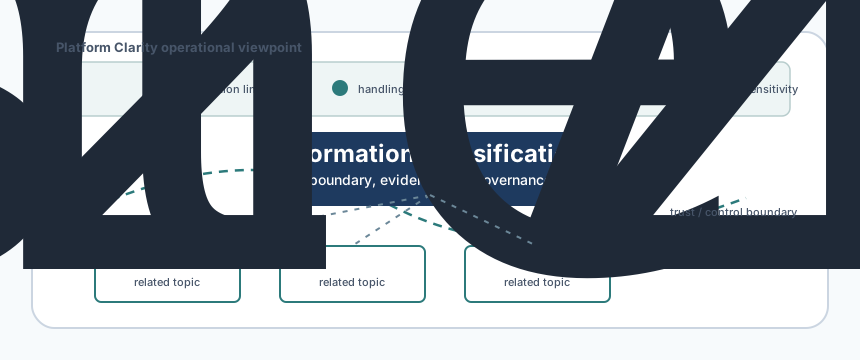
Platform Clarity perspective
The operational reading
Classification is valuable only when it changes how information moves. Labels that do not affect storage, access, sharing, retention or AI retrieval are administrative theatre.
Related operational concepts
- information lineage
- handling rules
- retrieval boundaries
- data sensitivity
- controlled disclosure
Observable signals
- unclassified sensitive stores
- classification drift
- export exceptions
- retention breaches
- cross-classification access
- AI retrieval coverage by class
When this becomes harmful
- labels are too broad to guide decisions
- everything becomes restricted
- teams create unmanaged copies
- AI tools ignore classification boundaries
Operational scenario
A document store has labels, but exports, chat summaries and AI retrieval ignore them. Classification review follows how information actually moves, where meaning can be inferred and which handling rules change system behaviour.
AI governance thread
AI increases classification pressure because inference can expose sensitive meaning even when individual documents appear safe in isolation.
Signals & failure patterns
What to look for before confidence becomes fragile.
These are not scorecards by themselves. They are review prompts: signs that flow, trust, governance or operational understanding may be degrading under pressure.
Failure patterns
- labels without handling rules
- everything restricted
- unmanaged copies
- classification ignored by AI retrieval
Pressure indicators
- classification drift
- export exceptions
- unclassified sensitive stores
- cross-classification access
Confidence erosion
- data labels do not change access or sharing
- meaning is inferred across documents
- retention and retrieval routes become unclear
From theory to operating reality
What changes under pressure
Classification matters only when it changes information movement. Under AI-enabled work, the question expands from document exposure to what sensitive meaning can be inferred across domains.
Knowledge graph
Read this with the neighbouring disciplines.
Platform Clarity treats each topic as part of an operating model: controls change flow, flow creates evidence, evidence changes governance, and governance must survive delivery pressure.
Visual pattern: Information lineage map showing classification, storage, sharing, retrieval and decision-use boundaries.
Introduction
Information classification is a practical way of deciding how information should be handled according to sensitivity, impact and obligation.
Why It Exists
It exists because organisations cannot protect everything in the same way and cannot safely govern data if they do not know what type of data they are handling.
Historical Context
Classification has long been used in government, defence and regulated sectors. Cloud platforms, SaaS and AI tooling now make it relevant to everyday business operations.
Core Principles
- Classification should guide handling, access, sharing, retention and monitoring.
- Labels must be simple enough for people to use.
- Controls should be proportionate to impact.
- Classification must follow data through systems and suppliers.
Operational Interpretation
In operational terms, Information Classification should change how people make decisions. It should influence review questions, design constraints, evidence expectations and escalation paths. If it only appears in policy documents, architecture packs or procurement questionnaires, it has not yet become part of the operating system of the organisation.
Common Misunderstandings
- Creating too many labels.
- Labelling documents but ignoring databases, logs and prompts.
- Treating classification as a compliance exercise only.
Common Failure Modes
- Sensitive data appears in test environments.
- AI prompts include confidential material because handling rules are unclear.
- Reports are exported without classification or access controls.
- Suppliers receive data beyond their contractual need.
Relationship To Other Frameworks
Information Classification rarely stands alone. It connects to the surrounding operating model because platforms are made of governance, delivery, security, data, people and evidence. The related topics below should be read as neighbouring disciplines rather than optional extras.
Practical Organisational Examples
- A firm separates public, internal, confidential and restricted data handling before approving AI assistant use.
- A health platform maps classification to logging so sensitive values are not stored in plain text.
- A merger review discovers incompatible classification schemes that block safe data sharing.
Worked Scenario
A product team wants to use production-like data for testing because synthetic data misses important edge cases. The request is reasonable from a quality perspective, but risky from an information-handling perspective. Without classification, the argument becomes quality versus security.
Classification allows a more precise answer. Which fields are restricted? Which can be masked? Which datasets can be generated? Which environments can hold which class of data? The decision becomes a practical handling design rather than a blanket yes or no.
Governance Implications
Governance should define labels, owners, handling rules and exception routes.
Delivery/Engineering Implications
Engineering teams need classification translated into data contracts, storage controls, masking, retention and test-data rules.
Architecture Implications
Architecture must show where classified data is stored, processed, copied, logged and exposed.
Evidence And Implementation Notes
Information classification should be visible in data inventories, access rules, retention schedules, export controls, logging standards, supplier contracts and AI tool policies. A label that does not change handling behaviour is not a control; it is decoration.
Implementation needs to be simple enough for people to use under pressure. Too many classes create confusion, but too few force materially different risks into the same bucket. The best schemes are boring, memorable and tied to concrete handling rules: who can access it, where it can be stored, whether it can be exported, whether it can enter AI tools and how long it should be retained.
For platform architecture, classification helps decide where boundaries need to exist. It affects API design, analytics, test-data handling, observability, support access and supplier assurance.
Trade-offs And Tensions
Information classification creates tension between protection and usability. If classification rules are too vague, people ignore them. If they are too complex, people guess or choose the safest label for everything, which makes the scheme less useful.
There is tension between data value and data exposure. Analytics, AI, product improvement and customer support all benefit from access to information. The same access can increase regulatory, contractual or reputational risk. Classification helps turn that tension into a design question: what data is needed, at what level of detail, under what controls?
Another tension is inheritance. Data can change risk when combined, exported, logged or moved into a new context. A low-risk field in one system may become sensitive when joined with another dataset or exposed to a supplier.
Implementation Pattern
Start with a small classification model and attach handling rules to each class. Define storage locations, access requirements, sharing rules, retention expectations, logging restrictions and AI usage restrictions. Then map the highest-risk data flows first.
Implementation should include tooling. Labels in documents, database tags, data catalogues, DLP rules, access groups and test-data controls all help classification become operational. Training alone is not enough.
Review classification during change. New integrations, analytics projects, AI pilots and supplier onboarding can all alter how data is used. Classification should be part of design review, not an afterthought.
What To Measure
Measure unclassified repositories, sensitive data in test environments, access to restricted datasets, data exports, retention exceptions, logging of sensitive fields, AI prompt/data incidents and supplier data-sharing coverage.
Also measure usability. If teams repeatedly ask how to classify common data types, the scheme may be unclear. If everything becomes confidential, the scheme may not be helping people make proportionate decisions.
When This Becomes Urgent
Information classification becomes urgent when data starts moving into new contexts: AI tools, analytics platforms, supplier environments, test systems, merger workstreams, customer exports or cross-border services. These moments change the consequence of old handling decisions.
The most common failure is assuming that because data already exists inside the organisation, any internal use is acceptable. Classification forces the organisation to ask whether the new use changes sensitivity, visibility, retention or obligation. It is particularly important when low-risk operational data becomes sensitive through aggregation.
Review evidence should include data inventories, classification labels, handling rules, access records, export approvals, test-data controls, retention policies and supplier data schedules. If those artefacts do not agree, the organisation is likely relying on individual judgement rather than a functioning classification system.
The first practical move is to classify a small number of high-value datasets and write the handling rules in operational language. Where may this data be stored? Who may access it? Can it enter AI tools? Can it be used in testing? Can it leave the UK? Those answers matter more than the label itself.
Good classification is boring in the best sense. People know the labels, understand the handling rules and can see those rules reflected in tooling. Support teams know what can be exported. Engineers know what can appear in logs. Analysts know what can be combined. AI users know what cannot be pasted into a prompt. The value is reduced ambiguity at the point of use.
Classification should also be reviewed after incidents and near misses. If sensitive information appears in a log, export, prompt, support ticket or test dataset, the question is not only who made the mistake. It is whether the classification model made the safe route clear enough and whether tooling supported it.
What Mature Organisations Do Differently
Mature organisations make classification usable and connect it to tooling.
Where Smaller Organisations Should Simplify
Smaller organisations should start with three or four labels and focus on the highest-impact data.
Operational Review Questions
- What decision is Information Classification meant to improve in this organisation?
- Which piece of evidence would show that it is working during normal delivery, not only during review?
- Where would teams work around it if deadlines compressed, an incident escalated or a supplier pushed back?
- Which exception would become dangerous if it quietly became normal practice?
- Which neighbouring topic changes the answer: AI Trust Zones, ISO 27001, Compartmentalisation?
Signals To Look For
A useful review looks for behaviour, not only artefacts. The strongest signal is usually not whether Information Classification is named in a policy, but whether it changes prioritisation, design, access, release, recovery or escalation. Look for repeated delays, unclear ownership, manual workarounds, unmanaged exceptions, untested assumptions and evidence that only appears when an audit or executive review is imminent.
The second signal is proportionality. Weak organisations either ignore the topic until something breaks or turn it into a heavy process that teams route around. Stronger organisations know where the topic matters most, where a lighter control is enough and where additional evidence is justified by risk.
Diagram Concept
The current topic diagram is a relationship map. A mature diagram for this page should show the operating boundary created by Information Classification: the decision points, ownership handovers, evidence loops, escalation routes and related concepts that make the idea inspectable. The visual should help a leader ask better questions and help an engineer understand what changes in delivery.
Related Topics
Start with AI Trust Zones, ISO 27001, Compartmentalisation. These relationships are deliberately practical: they show where this topic changes an adjacent architecture, governance or delivery conversation.
