
Security and assurance
NIST SP 800-53 Rev. 5
NIST SP 800-53 Rev. 5 as a broad control catalogue for governing security, privacy and operational assurance.
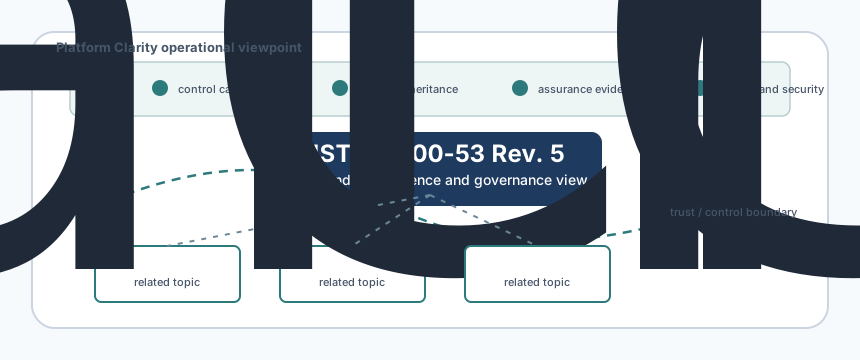
Platform Clarity perspective
The operational reading
NIST SP 800-53 is most useful as a control reasoning system. The value is not having many controls; it is understanding which controls apply, who operates them, and what evidence proves they work.
Related operational concepts
- control catalogue
- control inheritance
- assurance evidence
- privacy and security
- governance coverage
Observable signals
- control coverage
- inherited control gaps
- assessment finding recurrence
- control owner ambiguity
- exception age
- evidence freshness
When this becomes harmful
- controls are copied without tailoring
- evidence is collected but not used
- control ownership is unclear
- teams treat compliance coverage as risk reduction
Operational scenario
A regulated programme inherits many controls but cannot explain which teams operate them or what evidence proves effectiveness. NIST review turns the catalogue into control ownership, tailoring and assurance questions.
AI governance thread
AI systems introduce new combinations of access, audit, privacy, provenance and system interconnection concerns that need control tailoring rather than generic policy reuse.
Signals & failure patterns
What to look for before confidence becomes fragile.
These are not scorecards by themselves. They are review prompts: signs that flow, trust, governance or operational understanding may be degrading under pressure.
Failure patterns
- control copying without tailoring
- unclear control ownership
- evidence collection without use
- compliance coverage mistaken for risk reduction
Pressure indicators
- control owner ambiguity
- inherited control gaps
- assessment finding recurrence
- exception age
Confidence erosion
- controls exist but nobody operates them
- inherited responsibilities are assumed not tested
- evidence freshness decays
From theory to operating reality
What changes under pressure
NIST SP 800-53 is strongest as a control reasoning system. Under pressure, the value is knowing which controls matter, who operates them and what evidence proves effectiveness.
Knowledge graph
Read this with the neighbouring disciplines.
Platform Clarity treats each topic as part of an operating model: controls change flow, flow creates evidence, evidence changes governance, and governance must survive delivery pressure.
Visual pattern: Control inheritance map showing control family, owner, evidence source, exception and operational dependency.
Introduction
NIST SP 800-53 Rev. 5 is a comprehensive catalogue of security and privacy controls. Its operational value is not that every organisation should implement every control, but that it provides a structured language for assurance conversations.
Why It Exists
Organisations need to reason about controls consistently across systems, suppliers, cloud environments, data, identity and operations. NIST SP 800-53 Rev. 5 exists to help that reasoning become explicit rather than dependent on scattered local judgement.
Historical Context
The publication comes from a long-running NIST effort to standardise security and privacy control guidance for federal information systems and organisations. Revision 5 broadened the perspective, making controls more outcome-oriented and applicable beyond a narrow federal system boundary.
Core Principles
- Controls should be selected according to risk, system context and organisational mission.
- Security and privacy are connected disciplines, not separate paperwork streams.
- Control implementation requires evidence, ownership and assessment.
- Control catalogues are starting points for judgement, not substitutes for judgement.
Operational Interpretation
In operational terms, NIST SP 800-53 Rev. 5 should change how people make decisions. It should influence review questions, design constraints, evidence expectations and escalation paths. If it only appears in policy documents, architecture packs or procurement questionnaires, it has not yet become part of the operating system of the organisation.
Common Misunderstandings
- Treating the catalogue as a checklist to copy wholesale.
- Assuming control inheritance is valid without evidence.
- Focusing on documentation while operational behaviour remains unchanged.
Common Failure Modes
- Control owners are named but have no operational authority.
- Assessment evidence is assembled manually just before audit.
- Inherited cloud controls are misunderstood, leaving customer responsibilities unmanaged.
- Controls exist in policy but are not tested during incidents or change.
Relationship To Other Frameworks
NIST SP 800-53 Rev. 5 rarely stands alone. It connects to the surrounding operating model because platforms are made of governance, delivery, security, data, people and evidence. The related topics below should be read as neighbouring disciplines rather than optional extras.
Practical Organisational Examples
- A regulated platform maps access control, audit logging and configuration management controls to existing delivery pipelines so evidence is generated during normal work.
- A supplier assurance review uses the catalogue to ask precise questions about contingency planning, incident response and system interconnections.
- An AI pilot uses control families to examine data handling, monitoring, access, accountability and change control before moving into production.
Worked Scenario
A board asks whether a business-critical platform is “secure enough” before a new public-sector customer signs. Without a control catalogue, the answer risks becoming a collection of reassuring statements about cloud hosting, penetration testing and good engineers. None of those statements explains the actual control posture.
Using NIST SP 800-53 Rev. 5, the team can structure the conversation around access control, auditability, configuration management, incident response, contingency planning, supplier dependency and privacy. The catalogue does not make the decision for them, but it stops assurance being vague.
Governance Implications
Governance should decide which controls apply, who owns them, how evidence is collected and how exceptions expire. NIST becomes valuable when it clarifies accountability rather than expanding paperwork.
Delivery/Engineering Implications
Engineering teams need controls translated into practical backlog items and platform capabilities: logging defaults, secure baselines, access review automation, change records, recovery testing and vulnerability response.
Architecture Implications
Architecture teams can use NIST to identify where controls must sit: identity plane, network boundary, workload platform, data layer, monitoring system or supplier contract. The catalogue helps expose control gaps across a distributed estate.
Evidence And Implementation Notes
NIST SP 800-53 Rev. 5 is most useful when controls are mapped to actual systems and operating responsibilities. A control should have an owner, an implementation location, an evidence source and a review pattern. If the evidence only exists in a manually assembled audit pack, the organisation may have control documentation but not control operation.
Control inheritance needs particular care. Cloud providers, SaaS suppliers and managed service providers may operate parts of the control environment, but that does not remove the need to understand customer responsibilities, configuration choices, monitoring gaps and contractual evidence. Inherited confidence is not the same as inherited control.
For architecture review, the catalogue helps turn vague assurance concerns into precise questions: which boundary enforces access, which log source proves it, which recovery process has been tested and which exception has been accepted?
Trade-offs And Tensions
The strength of NIST SP 800-53 Rev. 5 is also its risk: it is broad enough to become overwhelming. Organisations can mistake coverage for maturity, producing control matrices that look impressive but do not change how systems are operated. The operational task is to select, tailor and evidence controls proportionately.
There is tension between control completeness and delivery usability. A control catalogue can help engineering teams by clarifying expectations, but it can also create a parallel compliance world if controls are translated into manual forms and late-stage approvals. The better approach is to embed control evidence into delivery platforms, change processes and operational tooling.
Another tension sits around accountability. Suppliers may provide control evidence, cloud providers may publish assurance reports and managed services may operate tooling, but the organisation still owns the risk decision. NIST helps clarify the conversation; it does not outsource judgement.
Implementation Pattern
Start by defining the system or service boundary. Then identify applicable control families, current implementation evidence, inherited controls, gaps and accepted risks. Avoid starting with every control at full depth. A critical regulated platform and an internal low-risk tool should not receive the same treatment.
Create a control profile that maps each selected control to an owner, implementation mechanism, evidence source and review frequency. Where possible, automate evidence collection: configuration baselines, access logs, vulnerability results, change records, backup tests and incident records.
Use control assessment as a learning loop. Findings should update architecture decisions, backlog priorities, supplier management and risk registers. If assessment findings do not change anything, the process is only measuring documentation.
What To Measure
Measure control implementation status, evidence freshness, assessment findings, exception age, remediation delay, inherited-control assumptions and repeat findings. The most important measure is not how many controls are marked complete; it is whether control evidence is current, relevant and connected to real systems.
For leadership, summarise by risk and consequence. Which control weaknesses could affect customer trust, operational continuity, regulatory exposure or acquisition value? Control catalogues only become executive-useful when they are translated into operational exposure.
When This Becomes Urgent
NIST SP 800-53 Rev. 5 becomes urgent when assurance questions need more precision than broad security claims can provide. This may happen during regulated onboarding, supplier assurance, public-sector work, acquisition due diligence, cyber insurance review or after a material incident.
The catalogue is particularly useful when stakeholders disagree about what “good enough” means. Instead of arguing in general terms, teams can discuss specific control families, implementation evidence, inherited responsibilities and residual risk. That does not remove judgement, but it gives judgement a clearer structure.
Review evidence should include system boundaries, selected controls, control owners, implementation statements, evidence sources, assessment findings, inherited-control assumptions, risk acceptances and remediation plans. If these cannot be connected to the live architecture, the organisation may have a control model that describes intent rather than operation.
What Mature Organisations Do Differently
Mature organisations map controls to real systems, automate evidence where possible and review control effectiveness after incidents and significant changes.
Where Smaller Organisations Should Simplify
Smaller organisations should use NIST as a reference library. Select the controls that match the risk profile, keep ownership clear and avoid pretending that a large catalogue automatically means maturity.
Operational Review Questions
- What decision is NIST SP 800-53 Rev. 5 meant to improve in this organisation?
- Which piece of evidence would show that it is working during normal delivery, not only during review?
- Where would teams work around it if deadlines compressed, an incident escalated or a supplier pushed back?
- Which exception would become dangerous if it quietly became normal practice?
- Which neighbouring topic changes the answer: Zero Trust, Information Classification, Operational Governance?
Signals To Look For
A useful review looks for behaviour, not only artefacts. The strongest signal is usually not whether NIST SP 800-53 Rev. 5 is named in a policy, but whether it changes prioritisation, design, access, release, recovery or escalation. Look for repeated delays, unclear ownership, manual workarounds, unmanaged exceptions, untested assumptions and evidence that only appears when an audit or executive review is imminent.
The second signal is proportionality. Weak organisations either ignore the topic until something breaks or turn it into a heavy process that teams route around. Stronger organisations know where the topic matters most, where a lighter control is enough and where additional evidence is justified by risk.
Diagram Concept
The current topic diagram is a relationship map. A mature diagram for this page should show the operating boundary created by NIST SP 800-53 Rev. 5: the decision points, ownership handovers, evidence loops, escalation routes and related concepts that make the idea inspectable. The visual should help a leader ask better questions and help an engineer understand what changes in delivery.
Related Topics
Start with Zero Trust, Information Classification, Operational Governance. These relationships are deliberately practical: they show where this topic changes an adjacent architecture, governance or delivery conversation.
