
AI governance
AI Trust Zones
AI trust zones as bounded operating environments for data exposure, model use, human oversight and organisational accountability.
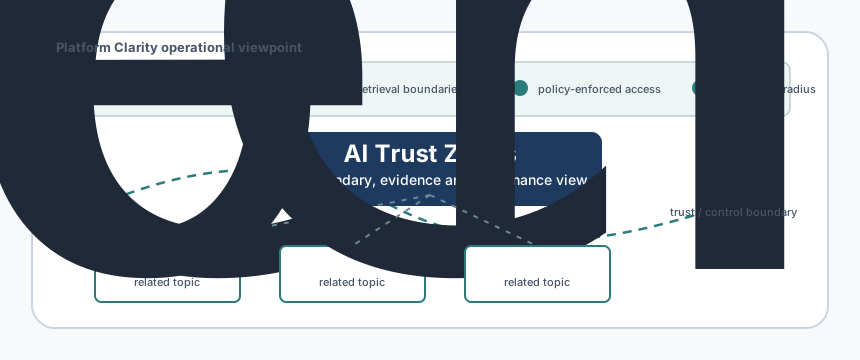
Platform Clarity perspective
The operational reading
High-performing organisations do not treat AI governance as a yes-or-no policy. They create zones where useful experimentation can move quickly while consequential use is slowed until evidence, access and accountability are strong enough.
Related operational concepts
- AI context aggregation
- retrieval boundaries
- policy-enforced access
- model blast radius
- human accountability
Observable signals
- use cases by zone
- unapproved AI tool usage
- sensitive-data prompt incidents
- retrieval boundary coverage
- human-review completion
- supplier AI terms coverage
When this becomes harmful
- zones become a permission bureaucracy
- safe experimentation is blocked by high-risk rules
- sensitive workflows are approved without evidence
- ownership sits only with policy teams
Operational scenario
A business unit wants to connect a copilot to product notes, supplier contracts and customer feedback. The review question is not whether the model works; it is which domains the model can correlate, which actions require human approval and what evidence exists when the answer influences a real decision.
AI governance thread
This is the AI-era control surface: it constrains what data and tools a model can reach, where inference risk appears, and how far a mistaken or over-permissive workflow can spread.
Signals & failure patterns
What to look for before confidence becomes fragile.
These are not scorecards by themselves. They are review prompts: signs that flow, trust, governance or operational understanding may be degrading under pressure.
Failure patterns
- unrestricted context aggregation
- policy-free orchestration
- invisible AI coupling
- high-risk use approved without evidence
Pressure indicators
- retrieval boundary violations
- context bleed
- unapproved AI tool usage
- supplier AI dependency growth
Confidence erosion
- AI usefulness expands faster than auditability
- sensitive workflows depend on prompts nobody can reconstruct
- domains collapse into one machine-readable context
From theory to operating reality
What changes under pressure
AI trust zones make machine interpretation governable. Under pressure, they prevent useful experimentation becoming uncontrolled access, inference and downstream action.
Knowledge graph
Read this with the neighbouring disciplines.
Platform Clarity treats each topic as part of an operating model: controls change flow, flow creates evidence, evidence changes governance, and governance must survive delivery pressure.
Visual pattern: AI trust zone map showing data sources, retrieval boundary, tool access, human review point and audit loop.
Introduction
AI trust zones are bounded operating environments for AI use. They separate low-risk experimentation from sensitive, regulated or decision-impacting use where stronger controls are needed.
Why It Exists
They exist because AI collapses old assumptions about data visibility, reuse and inference. A single policy cannot safely cover public content summarisation, internal productivity, customer-data analysis and automated decision support.
Historical Context
The idea draws from security zoning, compartmentalisation, data classification and model governance. It has become urgent because generative AI tools can move from experiment to operational dependency faster than traditional governance cycles.
Core Principles
- Define allowed data, models, users and purposes per zone.
- Match human oversight to consequence.
- Require auditability where outputs affect customers, staff, finances or compliance.
- Treat movement between zones as a governed transition.
Operational Interpretation
In operational terms, AI Trust Zones should change how people make decisions. It should influence review questions, design constraints, evidence expectations and escalation paths. If it only appears in policy documents, architecture packs or procurement questionnaires, it has not yet become part of the operating system of the organisation.
Common Misunderstandings
- Writing a broad AI acceptable-use policy and calling it governance.
- Blocking all AI use because high-risk cases are hard.
- Allowing all AI use because some cases are low-risk.
Common Failure Modes
- Sensitive data enters public tools through convenience.
- Teams build shadow AI workflows with no monitoring.
- Model outputs affect decisions without accountability.
- Suppliers use customer data in ways contracts did not anticipate.
Relationship To Other Frameworks
AI Trust Zones rarely stands alone. It connects to the surrounding operating model because platforms are made of governance, delivery, security, data, people and evidence. The related topics below should be read as neighbouring disciplines rather than optional extras.
Practical Organisational Examples
- A company permits public-content drafting in a low-risk zone but blocks customer-data prompts until a controlled enterprise tool is available.
- A regulated workflow uses AI to suggest case summaries but requires human approval, audit logging and source traceability.
- An engineering team separates code assistance from production-secret handling and vulnerability triage.
Worked Scenario
A sales team wants AI to summarise calls, draft proposals and analyse customer account notes. The productivity case is strong, but the data spans public material, confidential pricing, customer commitments and sometimes regulated personal information. A single allow-or-block decision is too crude.
AI trust zones split the work. Public drafting can move quickly. Internal account analysis needs approved tooling and retention rules. Regulated material requires stricter review, auditability and human accountability. The organisation can enable useful AI without pretending every use case has the same consequence.
Governance Implications
Governance should define zones, approval thresholds, data rules, model assurance, monitoring and escalation.
Delivery/Engineering Implications
Delivery teams need safe patterns: approved tools, prompt logging rules, data redaction, review workflows and rollback if AI behaviour becomes unsafe.
Architecture Implications
Architecture must show AI boundaries across data stores, identity, suppliers, APIs, monitoring and human decision points.
Evidence And Implementation Notes
AI trust zones need evidence about data, purpose, model route, human oversight, logging, supplier terms and output consequence. The review question is not simply whether AI is allowed. It is which zone the use case belongs in, what data may enter that zone and what evidence is required before the output can influence a real decision.
Implementation should separate low-risk productivity from high-consequence use. Drafting public text, summarising non-sensitive notes and helping with internal brainstorming may need light controls. Processing customer records, producing regulated advice, influencing hiring, changing financial outcomes or supporting safety decisions needs stronger review, traceability and accountability.
The difficult cases are usually hybrid. An apparently harmless assistant may gain access to confidential documents through retrieval, plugins or workflow automation. A useful zone model therefore covers data flow and tool capability, not just the label placed on the AI product.
Trade-offs And Tensions
AI trust zones create tension between experimentation and control. If governance is too slow, teams will use unsanctioned tools because the productivity benefit is immediate. If governance is too permissive, sensitive data and high-consequence decisions can enter systems that the organisation does not understand.
There is also tension between model capability and accountability. A more capable AI workflow may retrieve more data, call more tools and influence more decisions. That makes it useful, but it also increases the need for explainability, logging, human review and rollback.
The most awkward tension is reputational. A low-cost internal experiment can become externally visible if outputs reach customers, staff decisions or regulatory obligations. Trust zones help leaders see when a use case has crossed from productivity support into business consequence.
Implementation Pattern
Define a small number of zones and make them easy to understand. For example: public/low-risk experimentation, internal productivity, confidential business use, restricted regulated use and high-impact decision support. Each zone should define allowed data, approved tools, logging, human review, supplier constraints and escalation.
Create an intake route for new AI use cases. The route should ask practical questions: what data enters the tool, what output is produced, who relies on it, what happens if it is wrong, whether a human reviews it and whether the supplier can use the data.
Connect the zone model to technical controls. Approved tools, data-loss prevention, retrieval boundaries, prompt logging, access control and audit trails should support the policy. Otherwise the model depends entirely on individual judgement.
What To Measure
Measure AI use cases by zone, unapproved tool usage, sensitive-data incidents, high-risk use cases without review, supplier data-processing coverage, prompt or retrieval logging coverage and human-review completion where required.
Also measure drift. A use case may begin as low-risk drafting but later connect to customer data, workflow automation or decision support. Zone classification should be reviewed when capability changes.
When This Becomes Urgent
AI trust zones become urgent when experimentation starts touching confidential or consequential work. The warning signs are familiar: teams pasting customer information into assistants, suppliers adding AI features to existing products, copilots gaining access to broad document stores, or leaders asking for AI-enabled decision support before accountability is clear.
The urgency is not only technical. It is organisational. Once people experience a productivity gain, removing access becomes politically harder. That means the zone model needs to arrive early enough to enable safe use rather than appearing later as a restriction. A good early intervention is to publish a simple use-case route: what is allowed now, what needs review and what is not yet acceptable.
Review evidence should include a register of use cases, approved tools, data classes, supplier terms, logging posture, human review expectations and escalation routes. If the organisation cannot produce that evidence, it is probably governing AI by trust and habit.
The first practical move is usually not a grand AI governance board. It is a short, visible classification route for use cases, backed by a small review group that can make quick decisions. That gives teams a safe way to ask before experimenting with sensitive material.
What Mature Organisations Do Differently
Mature organisations let safe AI move quickly while slowing high-consequence use until evidence and controls are strong enough.
Where Smaller Organisations Should Simplify
Smaller organisations should define three zones: public/low-risk, internal/confidential and restricted/high-impact.
Operational Review Questions
- What decision is AI Trust Zones meant to improve in this organisation?
- Which piece of evidence would show that it is working during normal delivery, not only during review?
- Where would teams work around it if deadlines compressed, an incident escalated or a supplier pushed back?
- Which exception would become dangerous if it quietly became normal practice?
- Which neighbouring topic changes the answer: Compartmentalisation, Information Classification, Zero Trust?
Signals To Look For
A useful review looks for behaviour, not only artefacts. The strongest signal is usually not whether AI Trust Zones is named in a policy, but whether it changes prioritisation, design, access, release, recovery or escalation. Look for repeated delays, unclear ownership, manual workarounds, unmanaged exceptions, untested assumptions and evidence that only appears when an audit or executive review is imminent.
The second signal is proportionality. Weak organisations either ignore the topic until something breaks or turn it into a heavy process that teams route around. Stronger organisations know where the topic matters most, where a lighter control is enough and where additional evidence is justified by risk.
Diagram Concept
The current topic diagram is a relationship map. A mature diagram for this page should show the operating boundary created by AI Trust Zones: the decision points, ownership handovers, evidence loops, escalation routes and related concepts that make the idea inspectable. The visual should help a leader ask better questions and help an engineer understand what changes in delivery.
Related Topics
Start with Compartmentalisation, Information Classification, Zero Trust. These relationships are deliberately practical: they show where this topic changes an adjacent architecture, governance or delivery conversation.
