
Control and containment
Compartmentalisation
Compartmentalisation as controlled visibility, blast-radius reduction and need-to-know design for organisations and systems.
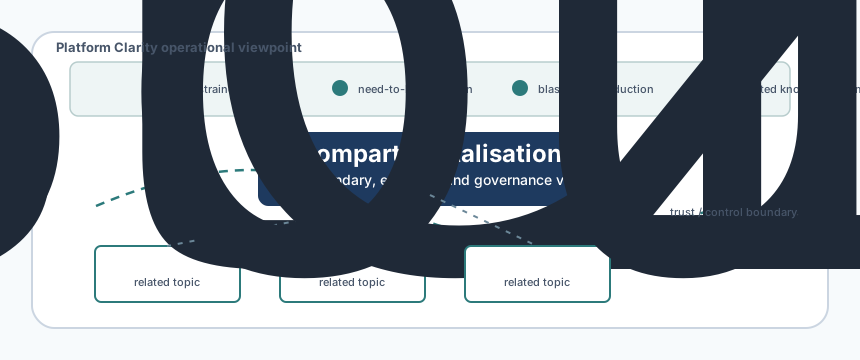
Platform Clarity perspective
The operational reading
Compartmentalisation is not secrecy for its own sake. It is controlled visibility: enough access for legitimate work, with enough separation to stop failure, misuse or inference spreading unchecked.
Related operational concepts
- constrained visibility
- need-to-know design
- blast radius reduction
- segregated knowledge domains
- controlled flow
Observable signals
- cross-domain access exceptions
- sensitive data exposure paths
- shared workspace sprawl
- retrieval scope breadth
- privileged group membership
- incident containment evidence
When this becomes harmful
- teams cannot collaborate safely
- boundaries become status barriers
- controls are bypassed through exports
- AI tools aggregate separated knowledge without review
Operational scenario
A prototype AI assistant is useful because it can search across teams, but that usefulness is also the risk. Compartmentalisation asks which knowledge domains should remain separate, which can be bridged and which correlations require explicit approval.
AI governance thread
AI is forcing organisations to rediscover compartmentalisation because retrieval, summarisation and tool-calling can collapse previously separate knowledge domains into one promptable surface.
Signals & failure patterns
What to look for before confidence becomes fragile.
These are not scorecards by themselves. They are review prompts: signs that flow, trust, governance or operational understanding may be degrading under pressure.
Failure patterns
- unmanaged copies
- collaboration paralysis
- status barriers
- AI context aggregation across separated domains
Pressure indicators
- cross-domain access exceptions
- retrieval scope breadth
- shared workspace sprawl
- sensitive export growth
Confidence erosion
- separation exists in policy but not tools
- staff bridge compartments informally
- AI systems infer across domains faster than review can see
From theory to operating reality
What changes under pressure
Compartmentalisation is controlled visibility. Under pressure, it must preserve legitimate work while stopping unnecessary correlation, exposure and failure spread.
Knowledge graph
Read this with the neighbouring disciplines.
Platform Clarity treats each topic as part of an operating model: controls change flow, flow creates evidence, evidence changes governance, and governance must survive delivery pressure.
Visual pattern: Compartment map showing need-to-know zones, controlled bridges, retrieval scope and model blast radius.
Introduction
Compartmentalisation is the discipline of limiting visibility, access and dependency so that compromise, error or misuse does not spread further than necessary. It is old thinking becoming newly important in AI-era architecture.
Why It Exists
Modern platforms make sharing easy. AI makes accidental exposure more consequential. Compartmentalisation exists because not every person, system, model or supplier needs to see everything, and because broad visibility creates broad blast radius.
Historical Context
The idea has roots in military and intelligence practice, where need-to-know principles protect sensitive operations. In technology, similar thinking appears in segmentation, least privilege, domain boundaries and data classification.
Core Principles
- Separate information according to sensitivity and operational need.
- Limit access to what is necessary for the role, process or system.
- Design failure boundaries so one compromise does not expose the whole estate.
- Review compartments as work changes, because yesterday’s sensible access may become tomorrow’s exposure.
Operational Interpretation
In operational terms, Compartmentalisation should change how people make decisions. It should influence review questions, design constraints, evidence expectations and escalation paths. If it only appears in policy documents, architecture packs or procurement questionnaires, it has not yet become part of the operating system of the organisation.
Common Misunderstandings
- Assuming compartmentalisation means secrecy for its own sake.
- Creating silos that block legitimate operational flow.
- Relying on organisational charts rather than data, system and decision boundaries.
Common Failure Modes
- Shared drives become informal data lakes with no classification.
- AI tools are allowed to process mixed sensitivity data because policy has not caught up.
- Integration platforms connect domains without clear ownership or monitoring.
- Emergency access becomes permanent because revocation is inconvenient.
Relationship To Other Frameworks
Compartmentalisation rarely stands alone. It connects to the surrounding operating model because platforms are made of governance, delivery, security, data, people and evidence. The related topics below should be read as neighbouring disciplines rather than optional extras.
Practical Organisational Examples
- A legal, HR and finance data environment is separated from general productivity AI tooling until classification and audit controls are mature.
- A post-acquisition integration keeps customer data compartments separate while identity, reporting and support processes are rationalised.
- A critical operations platform limits supplier visibility to the systems they maintain rather than granting broad estate access.
Worked Scenario
A business enables a generative AI assistant across its collaboration platform. At first the use case looks low risk: staff can summarise meetings, draft emails and find documents. The hidden problem is that document permissions have grown loose over years, so the assistant can surface material that people technically had access to but would never normally have found.
Compartmentalisation changes the preparation work. Before expanding AI access, the organisation separates HR, legal, finance, customer and operational material; reviews access groups; and decides which compartments can be searched by which tools. The AI discussion becomes a visibility and blast-radius discussion, not just a productivity discussion.
Governance Implications
Governance should define who can create compartments, who approves cross-compartment movement and what evidence shows that boundaries are respected. The point is not secrecy theatre; it is controlled operational exposure.
Delivery/Engineering Implications
Delivery teams need practical patterns: scoped service accounts, separate environments, data minimisation, approval workflows, logging and test data handling. If compartments make delivery impossible, people will route around them.
Architecture Implications
Architecture must show where compartments exist across data, identity, network, application, operational process and AI usage. The design question is where visibility should stop by default.
Evidence And Implementation Notes
The evidence for compartmentalisation is found in who can see what, which systems can talk to which other systems, how sensitive data is copied and how exceptions are approved. Review access groups, shared drives, SaaS permissions, integration routes, support access and AI tool usage. Broad convenience access is often the first sign that compartmentalisation has been discussed but not implemented.
Useful implementation begins with the highest-consequence compartments: regulated data, privileged operations, legal or HR material, production secrets, customer exports and supplier access. The aim is not to make work secretive. It is to ensure that accidental exposure, compromise or misuse does not create a whole-organisation incident.
AI makes this more urgent because prompts, retrieval systems and assistants can cross old boundaries silently. A compartment that was once protected by human habit may fail when content is ingested, summarised or reused by tools that were not part of the original control model.
Trade-offs And Tensions
Compartmentalisation creates tension because it restricts visibility in organisations that often value collaboration, speed and transparency. Done badly, it creates silos, duplicate work and frustration. Done well, it protects sensitive activity while preserving legitimate flow through defined routes.
The hardest tension is between need-to-know and need-to-operate. Support teams may need enough information to resolve incidents quickly. Analysts may need data to improve services. Leaders may need visibility across domains. Compartmentalisation should therefore define controlled routes for legitimate access rather than simply closing doors.
AI adds another tension: discovery versus exposure. The more an assistant can search, summarise and connect, the more valuable it becomes. The same capability can also surface information across boundaries that were previously protected by obscurity or habit.
Implementation Pattern
Start by identifying high-consequence information, operations and systems. Group them into compartments based on sensitivity, operational need, legal obligation, supplier exposure and blast radius. Then define who can access each compartment, through which systems, for which purposes and under what logging or approval requirements.
Design cross-compartment movement deliberately. Data exports, support escalation, analytics, reporting, AI retrieval and supplier access should all have visible routes. If movement is common, create a safe pattern. If movement is exceptional, require explicit approval and review.
Keep compartments understandable. A model with too many categories will fail socially. A useful design gives people a small number of clear rules and makes tooling enforce as much as possible.
What To Measure
Measure broad-access groups, stale permissions, cross-compartment data movement, exception age, sensitive data in general-purpose tools, supplier access coverage and unclassified repositories. For AI use, measure which tools can access which compartments and whether prompt or retrieval logs expose sensitive material.
The most revealing measure is usually exception growth. If exceptions keep increasing, the compartment model may be too restrictive, too unclear or out of step with how work actually happens.
When This Becomes Urgent
Compartmentalisation becomes urgent when visibility starts expanding faster than governance. This can happen during AI rollout, acquisition integration, supplier onboarding, data platform consolidation or emergency operational support. The organisation may believe access is controlled because permissions technically exist, while in practice too many people and tools can see too much.
The trigger question is simple: if this account, tool, supplier or model were misused, how far could the exposure spread? If the answer is unclear or uncomfortably broad, compartmentalisation needs attention.
Useful review evidence includes access group membership, document repository permissions, supplier access records, data export logs, AI retrieval scope, privileged access history and exception approvals. The goal is to see whether compartments exist in behaviour, not only in policy language.
What Mature Organisations Do Differently
Mature organisations treat compartmentalisation as a proportional design tool. They make boundary exceptions temporary, visible and reviewed.
Where Smaller Organisations Should Simplify
Smaller organisations should start with sensitive data separation, admin account separation, supplier access limits and clear rules for AI tool use.
Operational Review Questions
- What decision is Compartmentalisation meant to improve in this organisation?
- Which piece of evidence would show that it is working during normal delivery, not only during review?
- Where would teams work around it if deadlines compressed, an incident escalated or a supplier pushed back?
- Which exception would become dangerous if it quietly became normal practice?
- Which neighbouring topic changes the answer: AI Trust Zones, Information Classification, Trust Boundaries?
Signals To Look For
A useful review looks for behaviour, not only artefacts. The strongest signal is usually not whether Compartmentalisation is named in a policy, but whether it changes prioritisation, design, access, release, recovery or escalation. Look for repeated delays, unclear ownership, manual workarounds, unmanaged exceptions, untested assumptions and evidence that only appears when an audit or executive review is imminent.
The second signal is proportionality. Weak organisations either ignore the topic until something breaks or turn it into a heavy process that teams route around. Stronger organisations know where the topic matters most, where a lighter control is enough and where additional evidence is justified by risk.
Diagram Concept
The current topic diagram is a relationship map. A mature diagram for this page should show the operating boundary created by Compartmentalisation: the decision points, ownership handovers, evidence loops, escalation routes and related concepts that make the idea inspectable. The visual should help a leader ask better questions and help an engineer understand what changes in delivery.
Related Topics
Start with AI Trust Zones, Information Classification, Trust Boundaries. These relationships are deliberately practical: they show where this topic changes an adjacent architecture, governance or delivery conversation.
