
Architecture control
Architectural Segmentation
Architectural segmentation as the design of separable domains, failure boundaries and governed integration points.
Platform Clarity perspective
The operational reading
Segmentation is useful when it protects flow and recovery, not when it merely creates more boxes on a diagram. The test is whether boundaries still mean something during incidents, change and integration.
Related operational concepts
- blast radius reduction
- controlled interoperability
- segmentation zones
- dependency exposure
- recovery boundaries
Observable signals
- cross-zone dependency count
- shared database exceptions
- privileged access across segments
- integration failure concentration
- recovery time by segment
When this becomes harmful
- segments multiply without ownership
- boundaries block legitimate delivery flow
- shared services quietly reconnect everything
- exceptions become the real architecture
Operational scenario
A shared platform supports three business lines but one legacy integration can still reach common data stores. Segmentation review tests whether a defect, compromised identity or supplier mistake can be contained without stopping unrelated operations.
AI governance thread
AI retrieval and orchestration can bypass traditional segmentation unless knowledge domains, tools, identities and outputs are segmented as deliberately as infrastructure.
Signals & failure patterns
What to look for before confidence becomes fragile.
These are not scorecards by themselves. They are review prompts: signs that flow, trust, governance or operational understanding may be degrading under pressure.
Failure patterns
- segmentation bypass
- shared-service recoupling
- ownership-free zones
- exceptions becoming architecture
Pressure indicators
- cross-zone dependency count
- shared database exceptions
- integration failure concentration
- recovery time by segment
Confidence erosion
- failure spreads across nominal boundaries
- recovery requires whole-platform coordination
- integration paths are invisible until incidents
From theory to operating reality
What changes under pressure
Segmentation is operationally meaningful only when it changes how failure, access and change can spread. Boxes on a diagram do not reduce blast radius unless boundaries survive real use.
Knowledge graph
Read this with the neighbouring disciplines.
Platform Clarity treats each topic as part of an operating model: controls change flow, flow creates evidence, evidence changes governance, and governance must survive delivery pressure.
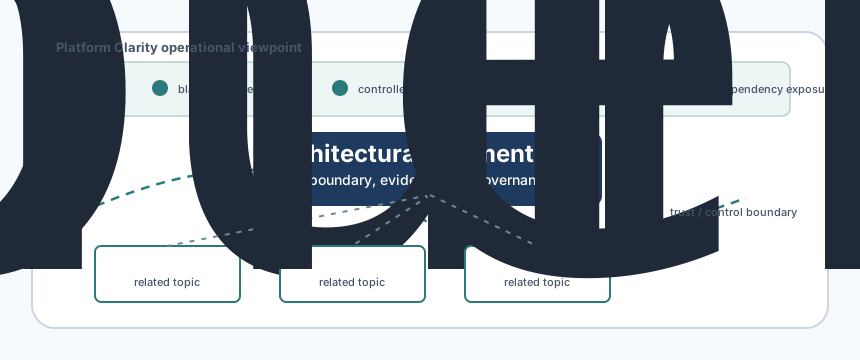
Visual pattern: Segmentation zone map with ownership, dependency crossings, policy gateways and blast-radius indicators.
Introduction
Architectural segmentation is the deliberate separation of systems, domains and responsibilities so that control, change and failure do not spread unnecessarily.
Why It Exists
It exists because highly connected systems are hard to govern, recover and secure. Segmentation gives organisations a way to reduce blast radius and make ownership clearer.
Historical Context
Segmentation has roots in network security, domain-driven design, resilience engineering and enterprise architecture. Modern cloud and platform architectures make it both easier and easier to get wrong.
Core Principles
- Separate domains with different risk, ownership or change rhythms.
- Make integration explicit and observable.
- Contain failure and compromise.
- Avoid segmentation that blocks legitimate flow.
Operational Interpretation
In operational terms, Architectural Segmentation should change how people make decisions. It should influence review questions, design constraints, evidence expectations and escalation paths. If it only appears in policy documents, architecture packs or procurement questionnaires, it has not yet become part of the operating system of the organisation.
Common Misunderstandings
- Thinking segmentation is only a network design issue.
- Creating too many boundaries and increasing operational overhead.
- Assuming microservices automatically create useful segmentation.
Common Failure Modes
- Shared databases undermine service boundaries.
- Network zones exist but identity permissions remain broad.
- Integration platforms become ungoverned bypass routes.
- Critical dependencies are hidden until an outage.
Relationship To Other Frameworks
Architectural Segmentation rarely stands alone. It connects to the surrounding operating model because platforms are made of governance, delivery, security, data, people and evidence. The related topics below should be read as neighbouring disciplines rather than optional extras.
Practical Organisational Examples
- A payments domain is segmented from general customer engagement services, with explicit APIs and monitoring.
- A cloud landing zone separates production, development and regulated workloads.
- A post-acquisition platform keeps high-risk legacy systems isolated while migration proceeds.
Worked Scenario
A platform is described as segmented because it has separate services and network zones. During an incident exercise, the team discovers that several services share the same database, administrators have broad access across zones and the reporting platform can query almost everything.
The segmentation review moves beyond infrastructure diagrams. It identifies data coupling, identity coupling, operational coupling and reporting bypasses. The improved design keeps legitimate integration but makes boundaries enforceable, observable and recoverable.
Governance Implications
Governance should approve boundary changes, integration exceptions and shared-service dependencies.
Delivery/Engineering Implications
Delivery teams need clear patterns for APIs, environments, data movement and shared platform services.
Architecture Implications
Architecture uses segmentation to manage complexity, autonomy, resilience and assurance.
Evidence And Implementation Notes
Architectural segmentation should be visible in environment design, network paths, identity scopes, service ownership, data stores, integration contracts and recovery plans. If everything still depends on a shared database, shared administrator group or shared release window, the segmentation may be more presentational than operational.
Implementation works best when segmentation follows real differences: risk, ownership, regulatory exposure, change frequency, failure impact or data sensitivity. Splitting systems because it looks modern can create unnecessary coordination cost. Failing to split systems where blast radius is high creates operational fragility.
Reviewers should look for bypass paths. Integration platforms, reporting exports, shared queues, service accounts and emergency access often reconnect segments that architecture diagrams present as separate.
Trade-offs And Tensions
Segmentation creates tension between autonomy and integration. Strong segmentation can reduce blast radius and clarify ownership, but it can also create duplication and coordination cost. Weak segmentation makes reuse easy in the short term but can leave the organisation with systems that fail, change and expose data together.
There is also tension between logical and physical separation. Two domains may be conceptually separate while sharing infrastructure, identity, data stores or operations staff. That may be acceptable, but it should be a conscious decision rather than a hidden dependency.
Modernisation programmes often make this tension sharper. Teams may want to split a legacy platform into services, but the real coupling may sit in data models, reporting needs, batch processes or organisational ownership.
Implementation Pattern
Start by identifying domains with different risk, change frequency, ownership or resilience needs. Then inspect the actual coupling: database, identity, network, deployment, monitoring, support, reporting and supplier routes.
Design segmentation around enforceable boundaries. APIs, events, contracts, environment separation, access scopes and recovery plans should make the segment meaningful. A boundary that cannot be operated during an incident is not mature.
Sequence migration carefully. Segmentation often needs transitional states where old and new boundaries coexist. Those states should be explicit, monitored and time-bound where possible.
What To Measure
Measure shared database dependency, cross-segment credentials, unowned integration routes, shared release constraints, incident blast radius, recovery independence and segmentation exceptions.
Also measure coupling over time. If new work repeatedly creates shortcuts across segments, the architecture may not match operational needs or the integration patterns may be too hard to use.
When This Becomes Urgent
Segmentation becomes urgent when one part of the estate can damage too much of the organisation. Typical triggers include acquisition integration, ransomware concern, cloud migration, platform modernisation, regulatory separation, repeated incidents or a legacy system that must remain longer than expected.
The first review should look for hidden coupling rather than obvious diagrams. Shared databases, administrator groups, reporting layers, batch jobs and support processes often matter more than service boundaries. If an incident in one domain would force a broad shutdown, or if recovery requires multiple unrelated teams to coordinate under pressure, segmentation is not yet doing enough work.
Good review evidence includes boundary diagrams, dependency maps, identity scopes, integration contracts, recovery tests, environment separation and known exceptions. The practical question is whether segmentation would still mean something during an incident, not whether the estate looks tidy in architecture tooling.
The first practical move is to pick one high-consequence domain and trace its real dependencies. Include administration routes, reporting, backup, monitoring, support processes and suppliers. That exercise often reveals that the named segment is less independent than assumed. From there, the organisation can decide whether to strengthen the boundary, document an exception or redesign the dependency.
Good segmentation is visible during change and during failure. During change, teams know which segment owns the decision, which interface must be respected and which dependencies need review. During failure, teams know what can be isolated, what will continue operating and which recovery path does not depend on the failed domain. If segmentation cannot help in those two moments, it is probably only structural decoration.
A useful review also asks what should not be segmented. Some shared capabilities are deliberately central because consistency, cost or operational control matters more than autonomy. Mature segmentation is selective: separate what creates risk or enables safe change, and keep shared what genuinely benefits from common ownership.
That selectivity is what keeps the model credible with delivery teams.
It also avoids turning architecture into a maze of unnecessary boundaries.
The best boundary is one people can understand, operate and defend.
What Mature Organisations Do Differently
Mature organisations segment according to risk and operating model, then monitor whether boundaries remain meaningful.
Where Smaller Organisations Should Simplify
Smaller organisations can start with production/non-production separation, admin separation and clear integration ownership.
Operational Review Questions
- What decision is Architectural Segmentation meant to improve in this organisation?
- Which piece of evidence would show that it is working during normal delivery, not only during review?
- Where would teams work around it if deadlines compressed, an incident escalated or a supplier pushed back?
- Which exception would become dangerous if it quietly became normal practice?
- Which neighbouring topic changes the answer: Trust Boundaries, Zero Trust, Compartmentalisation?
Signals To Look For
A useful review looks for behaviour, not only artefacts. The strongest signal is usually not whether Architectural Segmentation is named in a policy, but whether it changes prioritisation, design, access, release, recovery or escalation. Look for repeated delays, unclear ownership, manual workarounds, unmanaged exceptions, untested assumptions and evidence that only appears when an audit or executive review is imminent.
The second signal is proportionality. Weak organisations either ignore the topic until something breaks or turn it into a heavy process that teams route around. Stronger organisations know where the topic matters most, where a lighter control is enough and where additional evidence is justified by risk.
Diagram Concept
The current topic diagram is a relationship map. A mature diagram for this page should show the operating boundary created by Architectural Segmentation: the decision points, ownership handovers, evidence loops, escalation routes and related concepts that make the idea inspectable. The visual should help a leader ask better questions and help an engineer understand what changes in delivery.
Related Topics
Start with Trust Boundaries, Zero Trust, Compartmentalisation. These relationships are deliberately practical: they show where this topic changes an adjacent architecture, governance or delivery conversation.
