
Security architecture
Trust Boundaries
Trust boundaries as the points where assumptions change and evidence, control or verification must increase.
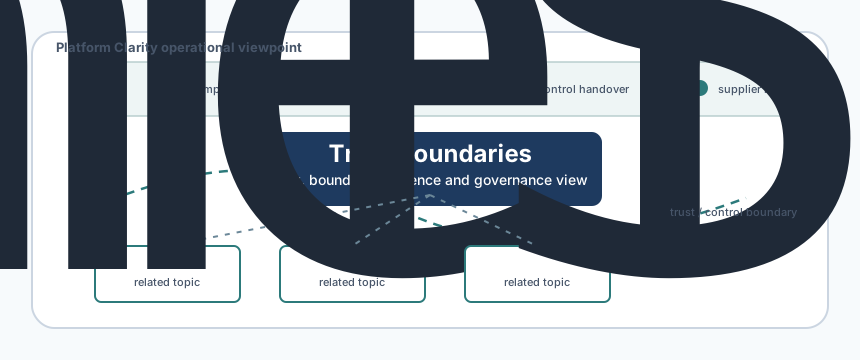
Platform Clarity perspective
The operational reading
A trust boundary is where an assumption stops being safe. Mature organisations make those points visible before access, data, responsibility or AI context crosses them.
Related operational concepts
- assumption change
- verification increase
- control handover
- supplier boundary
- AI retrieval boundary
Observable signals
- boundary crossings
- unmanaged export routes
- supplier access paths
- cross-boundary incidents
- logging coverage
- control bypass exceptions
When this becomes harmful
- boundaries exist only on diagrams
- every handoff becomes too slow
- bypass routes are ignored
- AI retrieval crosses zones without policy enforcement
Operational scenario
A supplier integration moves data, identity and operational responsibility across an unclear boundary. Trust-boundary review identifies where assumptions change and what verification, logging or contractual control must increase.
AI governance thread
AI creates new trust boundaries around retrieval, tool use, supplier models, generated outputs and the human decisions that rely on them.
Signals & failure patterns
What to look for before confidence becomes fragile.
These are not scorecards by themselves. They are review prompts: signs that flow, trust, governance or operational understanding may be degrading under pressure.
Failure patterns
- diagram-only boundaries
- unmanaged exports
- supplier ambiguity
- AI retrieval crossing domains without policy
Pressure indicators
- boundary crossings
- cross-boundary incidents
- supplier access paths
- control bypass exceptions
Confidence erosion
- assumptions change without review
- handoffs hide accountability
- data moves faster than control evidence
From theory to operating reality
What changes under pressure
A trust boundary is where the operating question changes. Under pressure, it should force a better answer about verification, ownership, logging, escalation and blast radius.
Knowledge graph
Read this with the neighbouring disciplines.
Platform Clarity treats each topic as part of an operating model: controls change flow, flow creates evidence, evidence changes governance, and governance must survive delivery pressure.
Visual pattern: Trust-boundary transition map showing source domain, crossing, policy enforcement, evidence and receiving domain.
Introduction
A trust boundary is a point where one set of assumptions stops being safe and another level of verification is needed. It may sit between networks, systems, organisations, data classifications, identities or operational roles.
Why It Exists
Trust boundaries exist because systems are not equally controlled, equally observable or equally risky. Without explicit boundaries, organisations accidentally carry trust from one context into another where it no longer belongs.
Historical Context
Security architecture has long used boundaries to reason about zones and controls. Cloud, SaaS, APIs, remote work and AI have made boundaries less physically obvious, but more important.
Core Principles
- Identify where control, ownership or sensitivity changes.
- Increase verification at the boundary.
- Reduce assumptions that cross the boundary automatically.
- Monitor boundary crossings because they often reveal risk.
Operational Interpretation
In operational terms, Trust Boundaries should change how people make decisions. It should influence review questions, design constraints, evidence expectations and escalation paths. If it only appears in policy documents, architecture packs or procurement questionnaires, it has not yet become part of the operating system of the organisation.
Common Misunderstandings
- Treating a network firewall as the only meaningful boundary.
- Drawing boundaries without assigning ownership.
- Ignoring process and data boundaries because they are less visible than infrastructure.
Common Failure Modes
- Internal APIs trust callers because they are on the same network.
- Supplier integrations use broad credentials without scoped access.
- Data crosses from regulated to general environments without classification checks.
- AI assistants receive content from multiple trust zones without guardrails.
Relationship To Other Frameworks
Trust Boundaries rarely stands alone. It connects to the surrounding operating model because platforms are made of governance, delivery, security, data, people and evidence. The related topics below should be read as neighbouring disciplines rather than optional extras.
Practical Organisational Examples
- A customer support tool becomes a trust boundary because agents, SaaS vendor staff and production customer data meet there.
- An analytics platform receives data from operational systems, requiring classification, lineage, access review and export controls.
- An internal admin portal is redesigned so privileged actions require stronger authentication and audit evidence.
Worked Scenario
A product team adds a customer analytics tool. Data leaves the core platform, enters a SaaS environment, is processed by vendor infrastructure and becomes visible to marketing users. The integration is treated as a small data export because no customer-facing feature changes.
A trust-boundary review reveals a different picture. Control, ownership, jurisdiction, access and monitoring all change at the integration point. The team adds data minimisation, scoped access, contractual review, audit logging and an export approval path. The boundary is no longer hidden inside a “simple integration”.
Governance Implications
Governance should require boundary registers for critical systems: what crosses, who owns it, what controls apply and how exceptions are reviewed.
Delivery/Engineering Implications
Engineering teams should model trust boundaries during design reviews, threat modelling and integration planning. Boundaries should influence API design, authentication, logging and error handling.
Architecture Implications
Architecture diagrams should show trust changes, not just components. A boundary that is invisible to architects will usually be invisible to delivery and operations too.
Evidence And Implementation Notes
A trust boundary should have visible enforcement. Evidence may include authentication flows, token scopes, firewall rules, API gateway policy, data classification checks, logging, supplier contract terms and incident response routes. If a boundary is only shown as a line on a diagram, it is not yet a control.
Reviewers should ask what changes when something crosses the boundary. Does identity need to be re-established? Does data need to be transformed or classified? Is additional logging required? Is ownership handed from one team to another? Is a supplier now involved? These questions turn abstract architecture diagrams into operating models.
The most dangerous boundaries are often the quiet ones: shared administration portals, reporting exports, message queues, integration platforms, support tooling and AI retrieval layers. They are easy to treat as plumbing, but they often carry the trust assumptions that determine real exposure.
Trade-offs And Tensions
Trust boundaries create tension between usability and verification. Every boundary crossing can add authentication, validation, logging or data handling requirements. Too little verification leaves implicit trust in place. Too much verification can slow legitimate work and encourage bypasses.
There is also tension between technical and organisational boundaries. A system may be technically internal but operationally controlled by a supplier. A shared SaaS platform may sit outside infrastructure ownership but inside critical business process. Trust boundaries therefore need to describe changes in control and accountability, not only network topology.
The most mature conversations accept that boundaries are not static. New integrations, AI tools, acquisitions, outsourcing and remote working can all move or create boundaries. A boundary model that is not reviewed during change quickly becomes historical fiction.
Implementation Pattern
Begin with critical journeys and data flows. Mark where ownership, identity, network, data classification, supplier involvement or operational control changes. For each boundary, define the control increase: authentication, authorisation, validation, encryption, logging, monitoring, contract requirement or human approval.
Then review bypass routes. Reporting extracts, support tools, queues, shared credentials and emergency access often cross the same boundary without equivalent controls. These routes need either redesign or explicit risk acceptance.
Finally, connect boundaries to incident response. During an incident, teams should know which boundary may have been crossed, which logs prove it and which containment action is available.
What To Measure
Useful measures include unowned integrations, shared credentials across boundaries, missing logs at boundary crossings, unreviewed supplier access, broad API scopes and exceptions to validation or authentication requirements.
Architectural quality can also be measured by explanation speed. If the organisation cannot quickly explain what crosses a boundary, who owns it and how it is monitored, the boundary is not yet operationally understood.
When This Becomes Urgent
Trust boundaries become urgent when systems, suppliers, users or data start crossing contexts faster than architecture and governance can explain. Common triggers include SaaS adoption, API expansion, supplier access, analytics exports, AI retrieval, remote operations and post-acquisition integration.
The risk is often hidden because the change looks small. A new integration, report, admin route or support tool may quietly move data or authority across a boundary. If the organisation does not recognise the boundary, it will not increase verification, monitoring or ownership.
Review evidence should include data-flow diagrams, API inventories, authentication flows, supplier access routes, logging coverage, classification checks and boundary exceptions. A boundary is operational when people can explain what changes at that point and which control proves it.
The first practical move is to take one integration and describe the boundary in plain language: what crosses, who controls each side, which identity is trusted, what data changes sensitivity and which logs would prove misuse. If that cannot be answered, the integration is carrying hidden trust.
What Mature Organisations Do Differently
Mature organisations keep trust boundary models current and tie them to incident review, supplier assurance and change control.
Where Smaller Organisations Should Simplify
Smaller organisations can begin by marking where customer data, admin access, supplier access and production systems meet less-controlled environments.
Operational Review Questions
- What decision is Trust Boundaries meant to improve in this organisation?
- Which piece of evidence would show that it is working during normal delivery, not only during review?
- Where would teams work around it if deadlines compressed, an incident escalated or a supplier pushed back?
- Which exception would become dangerous if it quietly became normal practice?
- Which neighbouring topic changes the answer: Zero Trust, Compartmentalisation, Architectural Segmentation?
Signals To Look For
A useful review looks for behaviour, not only artefacts. The strongest signal is usually not whether Trust Boundaries is named in a policy, but whether it changes prioritisation, design, access, release, recovery or escalation. Look for repeated delays, unclear ownership, manual workarounds, unmanaged exceptions, untested assumptions and evidence that only appears when an audit or executive review is imminent.
The second signal is proportionality. Weak organisations either ignore the topic until something breaks or turn it into a heavy process that teams route around. Stronger organisations know where the topic matters most, where a lighter control is enough and where additional evidence is justified by risk.
Diagram Concept
The current topic diagram is a relationship map. A mature diagram for this page should show the operating boundary created by Trust Boundaries: the decision points, ownership handovers, evidence loops, escalation routes and related concepts that make the idea inspectable. The visual should help a leader ask better questions and help an engineer understand what changes in delivery.
Related Topics
Start with Zero Trust, Compartmentalisation, Architectural Segmentation. These relationships are deliberately practical: they show where this topic changes an adjacent architecture, governance or delivery conversation.
