
Enterprise architecture
Capability Mapping
Capability mapping as a way to reason about what an organisation must be able to do before arguing about systems.
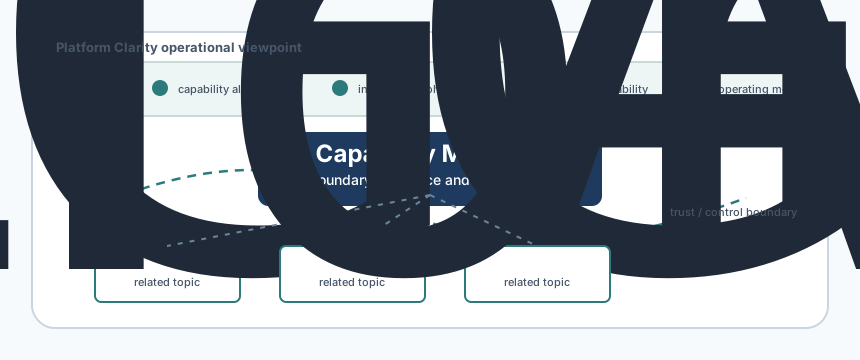
Platform Clarity perspective
The operational reading
Capability mapping earns its keep when it changes sequencing and investment decisions. If it cannot expose duplication, dependency and operational pressure, it is probably decoration.
Related operational concepts
- capability alignment
- investment coherence
- duplicated capability
- operating model fit
- rationalisation pressure
Observable signals
- duplicated systems per capability
- capability heat
- change demand by capability
- cost-to-serve
- ownership ambiguity
- incident load by capability
When this becomes harmful
- maps mirror the org chart
- heat reflects politics rather than evidence
- detail overwhelms decision making
- nobody uses the model in funding or delivery governance
Operational scenario
After acquisition, two teams claim to own the same customer onboarding capability through different systems. Capability mapping exposes duplication, integration pressure and where rationalisation would either reduce cost or create operational risk.
AI governance thread
AI investment should be routed through capability need rather than novelty, especially where automation touches high-friction work, regulated judgement or duplicated operating capability.
Signals & failure patterns
What to look for before confidence becomes fragile.
These are not scorecards by themselves. They are review prompts: signs that flow, trust, governance or operational understanding may be degrading under pressure.
Failure patterns
- org-chart mapping
- politically weighted heat
- unused models
- duplication hidden by naming differences
Pressure indicators
- capability heat
- duplicated systems
- ownership ambiguity
- cost-to-serve pressure
Confidence erosion
- rationalisation plans miss operating duplication
- leaders cannot see which capabilities carry risk
- investment follows systems not outcomes
From theory to operating reality
What changes under pressure
Capability mapping is useful when it clarifies what the organisation must be able to do and where systems, people and cost do not line up. It is decoration when nobody uses it to change sequencing or investment.
Knowledge graph
Read this with the neighbouring disciplines.
Platform Clarity treats each topic as part of an operating model: controls change flow, flow creates evidence, evidence changes governance, and governance must survive delivery pressure.
Visual pattern: Capability-to-system overlay showing duplicated capability, operational heat, dependency load and rationalisation path.
Introduction
Capability mapping describes what an organisation must be able to do, independent of which team or system currently does it.
Why It Exists
It exists because technology conversations often start with systems before anyone has agreed the business capabilities being protected, improved or retired.
Historical Context
Capability-based planning became important as enterprise architecture shifted from application inventories towards business-aligned change.
Core Principles
- Capabilities should be stable enough to guide change.
- Maps should expose duplication, gaps and investment pressure.
- Capability heat should be based on evidence, not preference.
- Systems, data and ownership should be linked back to capability.
Operational Interpretation
In operational terms, Capability Mapping should change how people make decisions. It should influence review questions, design constraints, evidence expectations and escalation paths. If it only appears in policy documents, architecture packs or procurement questionnaires, it has not yet become part of the operating system of the organisation.
Common Misunderstandings
- Creating attractive maps that do not affect investment.
- Confusing organisational structure with capability.
- Mapping at such detail that the model becomes unusable.
Common Failure Modes
- Duplicated systems survive because duplicated capabilities were never acknowledged.
- Modernisation targets technical assets but not business outcomes.
- Capability ownership is unclear after reorganisation.
- Heat maps reflect politics rather than operational evidence.
Relationship To Other Frameworks
Capability Mapping rarely stands alone. It connects to the surrounding operating model because platforms are made of governance, delivery, security, data, people and evidence. The related topics below should be read as neighbouring disciplines rather than optional extras.
Practical Organisational Examples
- An acquisition review maps both companies against customer onboarding, billing and support to find rationalisation risk.
- A SaaS replacement is paused when the capability map shows the real problem is fragmented ownership.
- An AI investment is routed to high-friction capabilities rather than fashionable use cases.
Worked Scenario
Two departments each request funding for separate workflow platforms. Both business cases are plausible, both have executive sponsors and both claim urgency. Without a capability view, the discussion becomes political: which department has the stronger case?
A capability map reframes the issue. The organisation can see that both requests support the same underlying case-management capability, but with different data, controls and customer journeys. The decision becomes whether to consolidate, sequence or deliberately allow variation because the capability contexts are genuinely different.
Governance Implications
Capability maps help governance prioritise investment and challenge local optimisation.
Delivery/Engineering Implications
Delivery teams benefit when scope is framed around capability outcomes rather than system replacement slogans.
Architecture Implications
Architecturally, capability maps connect business intent to applications, data, integrations and transition states.
Evidence And Implementation Notes
The evidence behind a capability map should include systems, data stores, owners, costs, incidents, customer pain, regulatory exposure and delivery demand. Without this evidence, a capability map is just a tidy abstraction. With it, the map becomes a way to discuss investment, duplication and risk without starting from vendor preferences.
Implementation works best when capability maps are stable enough to survive organisational reshuffles but detailed enough to inform decisions. If the map mirrors the current org chart too closely, it will change whenever reporting lines change. If it is too abstract, it will not help prioritise work.
The practical question is whether the map changes sequencing. If two programmes claim the same capability, if a capability is strategically important but operationally fragile, or if a low-value capability consumes disproportionate support effort, the map should make that visible.
Trade-offs And Tensions
Capability mapping creates tension because it abstracts away from systems and teams, while most organisations are used to funding systems and teams. That abstraction is the point, but it can feel uncomfortable. A capability map may show that a favoured platform is not strategically central, or that an unfashionable process is actually critical to customer outcomes.
There is also tension between stability and usefulness. A capability model should not change every time the organisation restructures, but it must still reflect real operating change. If it becomes frozen, people stop using it. If it changes constantly, it cannot guide investment.
The political tension is duplication. Capability maps often reveal that different departments have built similar capabilities for local reasons. Rationalisation may be logical, but local variation may still be justified by regulation, geography, customer segment or operational risk.
Implementation Pattern
Begin with a small number of business capabilities expressed in plain language. Avoid starting at excessive detail. Map systems, data, owners, costs, risk and demand against those capabilities. Then add heat: which capabilities are strategically important, operationally fragile, duplicated, underfunded or constrained by obsolete platforms?
Use the map in decisions quickly. A capability map that is not used in planning will become shelfware. Bring it into investment review, acquisition integration, platform rationalisation and AI opportunity assessment.
Keep ownership clear. Someone must maintain the model and challenge changes. Otherwise the map will quietly drift into whatever the last workshop produced.
What To Measure
Measure duplicated capability spend, number of systems per capability, capability owner clarity, high-heat capabilities without funded work, incidents or customer complaints by capability and roadmap alignment to strategic capability gaps.
The most useful measurement is decision impact. If the capability map never changes funding, sequencing or scope, it is not yet doing organisational work.
When This Becomes Urgent
Capability mapping becomes urgent when the organisation is about to make a large investment without a stable view of what the business must actually be able to do. Common triggers include merger integration, platform rationalisation, enterprise SaaS selection, operating-model redesign, AI investment planning and cost reduction.
The risk is that leaders optimise the visible system estate while preserving the underlying capability confusion. A business can replace tools and still leave customer onboarding fragmented, reporting duplicated or support ownership unclear. Capability mapping makes those operating questions visible before the technology decision hardens.
Review evidence should include capability ownership, supporting systems, key data, process maturity, operational pain, investment demand and strategic importance. The map should show not only what exists, but where the organisation is carrying duplicated effort, underfunded critical capability or capability gaps that block strategy.
The first practical move is to build a one-page capability heat map for a single strategic question. Do not attempt to map the whole enterprise immediately. Use the map to test a decision: which capability is constrained, which systems support it, who owns it and what would improve if funding moved there? If the map changes the conversation, expand it.
Good capability mapping gives leaders a way to discuss change without immediately arguing about products, suppliers or departmental ownership. It should show where business ambition depends on fragile capability, where systems duplicate one another and where investment is being pulled towards symptoms rather than causes. The map is successful when it slows a premature technology decision and improves the quality of the choice.
What Mature Organisations Do Differently
Mature organisations keep maps lightweight, current and connected to funding.
Where Smaller Organisations Should Simplify
Smaller organisations can map ten to twenty core capabilities and use them in quarterly planning.
Operational Review Questions
- What decision is Capability Mapping meant to improve in this organisation?
- Which piece of evidence would show that it is working during normal delivery, not only during review?
- Where would teams work around it if deadlines compressed, an incident escalated or a supplier pushed back?
- Which exception would become dangerous if it quietly became normal practice?
- Which neighbouring topic changes the answer: TOGAF, Operational Governance, Operational Flow?
Signals To Look For
A useful review looks for behaviour, not only artefacts. The strongest signal is usually not whether Capability Mapping is named in a policy, but whether it changes prioritisation, design, access, release, recovery or escalation. Look for repeated delays, unclear ownership, manual workarounds, unmanaged exceptions, untested assumptions and evidence that only appears when an audit or executive review is imminent.
The second signal is proportionality. Weak organisations either ignore the topic until something breaks or turn it into a heavy process that teams route around. Stronger organisations know where the topic matters most, where a lighter control is enough and where additional evidence is justified by risk.
Diagram Concept
The current topic diagram is a relationship map. A mature diagram for this page should show the operating boundary created by Capability Mapping: the decision points, ownership handovers, evidence loops, escalation routes and related concepts that make the idea inspectable. The visual should help a leader ask better questions and help an engineer understand what changes in delivery.
Related Topics
Start with TOGAF, Operational Governance, Operational Flow. These relationships are deliberately practical: they show where this topic changes an adjacent architecture, governance or delivery conversation.
