
Enterprise architecture framework
TOGAF
TOGAF as an operating discipline for coordinating change across capability, governance, technology and investment decisions.
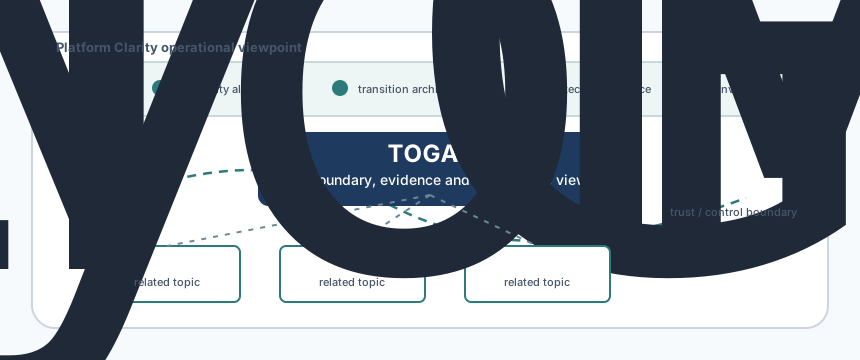
Platform Clarity perspective
The operational reading
TOGAF has value when it connects strategy, capability, transition states and delivery evidence. If it only produces artefacts after decisions are already made, it has become architecture theatre.
Related operational concepts
- capability alignment
- transition architecture
- architecture evidence
- investment coherence
- delivery integration
Observable signals
- decision traceability
- roadmap dependency age
- exception count
- capability-to-system coverage
- transition state risk
- architecture review timing
When this becomes harmful
- method becomes ceremony
- architecture advice arrives after funding
- artefacts disagree
- governance protects documents rather than delivery coherence
Operational scenario
A transformation has architecture boards and roadmaps, but supplier choices, funding and delivery sequencing have already hardened before architecture can influence them. TOGAF review reconnects architecture governance with capability, transition state and delivery evidence.
AI governance thread
AI adoption needs enterprise architecture because model access, data flows, suppliers and decision impact cut across capability, security and operating model boundaries.
Signals & failure patterns
What to look for before confidence becomes fragile.
These are not scorecards by themselves. They are review prompts: signs that flow, trust, governance or operational understanding may be degrading under pressure.
Failure patterns
- architecture theatre
- documentation-first behaviour
- late review
- governance layering without delivery effect
Pressure indicators
- architecture review timing
- roadmap dependency age
- exception growth
- transition state risk
Confidence erosion
- artefacts disagree with delivery
- funding decisions outrun architecture
- capability intent detaches from system reality
From theory to operating reality
What changes under pressure
TOGAF has value when it helps architecture influence sequencing, investment and transition risk. Under pressure, its test is whether it changes decisions before commitments harden.
Knowledge graph
Read this with the neighbouring disciplines.
Platform Clarity treats each topic as part of an operating model: controls change flow, flow creates evidence, evidence changes governance, and governance must survive delivery pressure.
Visual pattern: Architecture governance overlay showing capability, transition state, decision record, delivery dependency and exception.
Introduction
TOGAF is useful when it is treated as a discipline for coordinating change, not as a certification vocabulary exercise. Its value is the way it helps an organisation connect capability, business intent, architecture, delivery planning and governance decisions over time.
Why It Exists
Large organisations rarely fail because they lack individual projects. They fail because too many projects optimise locally. TOGAF exists to give architecture work a repeatable route from intent to transition planning, so investment decisions, capability gaps and technology changes do not drift into separate conversations.
Historical Context
TOGAF grew out of enterprise architecture practice at a time when organisations needed more disciplined ways to manage complex technology estates. The historical pressure was simple: informal architecture coordination could not keep pace with distributed systems, outsourced delivery, merger activity and increasingly regulated change.
Core Principles
- Architecture should be tied to business capability and operating need, not only system diagrams.
- Transition planning matters because most organisations live with hybrid old-and-new reality for years.
- Governance is valuable when it protects coherence and exposes trade-offs, not when it becomes document theatre.
- Architecture decisions need enough evidence to survive delivery pressure.
Operational Interpretation
In operational terms, TOGAF should change how people make decisions. It should influence review questions, design constraints, evidence expectations and escalation paths. If it only appears in policy documents, architecture packs or procurement questionnaires, it has not yet become part of the operating system of the organisation.
Common Misunderstandings
- Treating the ADM as a rigid waterfall process.
- Believing TOGAF adoption means creating more artefacts rather than better decisions.
- Confusing enterprise architecture governance with a late-stage approval board.
Common Failure Modes
- Teams produce architecture packs that nobody uses during delivery.
- Capability maps exist but are not connected to funding or prioritisation.
- Architecture review happens after commitments have already been made.
- Exceptions accumulate until the official architecture no longer describes the platform.
Relationship To Other Frameworks
TOGAF rarely stands alone. It connects to the surrounding operating model because platforms are made of governance, delivery, security, data, people and evidence. The related topics below should be read as neighbouring disciplines rather than optional extras.
Practical Organisational Examples
- A bank uses TOGAF language to align a payments modernisation programme with customer onboarding, fraud operations and regulatory reporting rather than treating it as an isolated platform rewrite.
- After an acquisition, a technology leader maps duplicated capabilities before rationalising systems, avoiding a premature tooling decision that would preserve duplicated processes.
- A public sector programme uses transition architecture to explain why some legacy integration must remain for two years and what controls are required during that period.
Worked Scenario
A leadership team approves a customer platform replacement because the existing system is expensive and difficult to change. Without an architecture method, the programme becomes a procurement exercise: compare products, select a supplier, migrate data and switch channels. The risk is that the replacement preserves the same fragmented onboarding, fraud and service processes in a newer tool.
Through a TOGAF lens, the question changes. The team maps the capabilities affected, documents the current and target operating states, identifies transition architectures and records which constraints will remain during migration. The result is not a larger pile of documents. It is a clearer conversation about what must change first, what can safely remain temporary and where governance must protect coherence.
Governance Implications
Governance should connect architecture decisions to funding, risk appetite and delivery evidence. A useful TOGAF implementation makes exceptions visible, records why choices were made and periodically checks whether transition assumptions still hold.
Delivery/Engineering Implications
Delivery teams need TOGAF translated into working constraints: interfaces, data movement, ownership, release sequencing, operational handover and migration risk. If architects cannot explain what changes for engineers next sprint or next quarter, the framework remains too abstract.
Architecture Implications
Architecturally, TOGAF is strongest when it connects current state, target state and transition states through capability. It should help leaders understand which parts of the estate are strategic, which are temporary and which are becoming operational drag.
Evidence And Implementation Notes
Good TOGAF implementation leaves a trail of connected evidence: capability maps, transition architecture, decision records, exception logs, roadmap dependencies and governance minutes that explain why sequencing choices were made. The value is not the existence of each artefact. The value is whether the artefacts agree with each other and whether delivery teams can use them without needing an architect to translate everything in real time.
In review work, look for the points where the architecture method meets money and delivery. If investment cases do not reference capabilities, if transition states are not funded, or if architecture risks are not visible in programme governance, TOGAF is probably being used as a descriptive framework rather than an operating discipline.
The practical test is whether leaders can answer three questions: what capability are we improving, what architecture state are we moving through, and what decision would change if new evidence appeared?
Trade-offs And Tensions
TOGAF creates tension because it asks for coherence in organisations that often reward local speed. A product team may want to optimise for rapid delivery, while enterprise architecture is trying to protect long-term operability, integration consistency and investment alignment. Neither side is automatically wrong. The useful work is to make the trade-off visible enough that leaders understand what they are buying.
The second tension is between method and ceremony. Too little structure leaves architecture dependent on memory and influence. Too much structure turns architecture into a compliance layer that delivery teams learn to navigate around. Mature use of TOGAF is therefore selective. It applies more discipline where risk, cost, dependency or organisational impact is high, and less where a lightweight decision record is enough.
There is also a political tension. Capability maps and transition plans can expose duplication, underfunded platforms and executive pet projects. If governance is not prepared to act on those discoveries, the framework will produce uncomfortable evidence without authority.
Implementation Pattern
Start with a thin operating model rather than a full artefact catalogue. Define the decision types TOGAF is meant to improve: investment sequencing, capability rationalisation, platform replacement, merger integration, target-state definition or exception approval. Then decide the minimum artefacts needed to support those decisions.
For many organisations, the starting set is enough: a capability map, current-state view, target-state view, transition roadmap, architecture principles, decision log and exception register. Each artefact should have an owner, a review cadence and a known audience. If nobody knows who uses an artefact, it will decay quickly.
The implementation should connect architecture review to funding and delivery gates. Architecture advice given after budget approval or supplier selection usually arrives too late. The earlier architecture contributes to option shaping, the more useful it becomes. This is where TOGAF is strongest: not as a late-stage control, but as a way to structure change before commitments harden.
What To Measure
Measurement should focus on whether architecture improves decisions. Useful signals include the number of unresolved architecture exceptions, percentage of major investments mapped to capabilities, transition roadmap drift, duplicate capability spend, decision-record quality and the age of unreviewed target-state assumptions.
Also measure friction. If architecture reviews repeatedly delay work without changing decisions, the process is probably too late or too heavy. If major programmes regularly bypass review, the governance route is not trusted. If architecture recommendations are accepted but not funded, the issue is not methodology; it is executive alignment.
When This Becomes Urgent
TOGAF becomes urgent when change is too broad for informal coordination: major platform replacement, acquisition integration, target operating model change, regulatory remediation, cloud transformation or repeated architectural exceptions. At that point, local decisions can easily undermine one another.
Review evidence should show how strategy becomes architecture and how architecture becomes delivery sequencing. If leaders cannot connect business capability, transition state, funding and delivery risk, the organisation is probably relying on confidence rather than architecture governance.
What Mature Organisations Do Differently
Mature organisations use just enough TOGAF to make decisions coherent. They keep architecture boards close to delivery, review exceptions, maintain capability maps and connect architecture principles to measurable operational outcomes.
Where Smaller Organisations Should Simplify
Smaller organisations should borrow the discipline, not the ceremony. A simple capability map, decision log, target-state sketch and monthly architecture review may deliver more value than trying to recreate enterprise artefact sets.
Operational Review Questions
- What decision is TOGAF meant to improve in this organisation?
- Which piece of evidence would show that it is working during normal delivery, not only during review?
- Where would teams work around it if deadlines compressed, an incident escalated or a supplier pushed back?
- Which exception would become dangerous if it quietly became normal practice?
- Which neighbouring topic changes the answer: Capability Mapping, Operational Governance, Operational Flow?
Signals To Look For
A useful review looks for behaviour, not only artefacts. The strongest signal is usually not whether TOGAF is named in a policy, but whether it changes prioritisation, design, access, release, recovery or escalation. Look for repeated delays, unclear ownership, manual workarounds, unmanaged exceptions, untested assumptions and evidence that only appears when an audit or executive review is imminent.
The second signal is proportionality. Weak organisations either ignore the topic until something breaks or turn it into a heavy process that teams route around. Stronger organisations know where the topic matters most, where a lighter control is enough and where additional evidence is justified by risk.
Diagram Concept
The current topic diagram is a relationship map. A mature diagram for this page should show the operating boundary created by TOGAF: the decision points, ownership handovers, evidence loops, escalation routes and related concepts that make the idea inspectable. The visual should help a leader ask better questions and help an engineer understand what changes in delivery.
Related Topics
Start with Capability Mapping, Operational Governance, Operational Flow. These relationships are deliberately practical: they show where this topic changes an adjacent architecture, governance or delivery conversation.
