
Delivery systems
Operational Flow
Operational flow as the movement of work, decisions, evidence and feedback through the organisation.
Platform Clarity perspective
The operational reading
Operational flow shows where intent becomes delayed, distorted or blocked. It is often the first honest view of whether governance, architecture and delivery are working together.
Related operational concepts
- work movement
- queue depth
- approval latency
- delivery friction
- constraint visibility
Observable signals
- queue depth
- wait time
- approval latency
- blocked work age
- rework loops
- handoff count
- decision cycle time
When this becomes harmful
- speed is optimised without control
- flow measures become pressure tools
- local optimisation pushes risk downstream
- necessary governance is treated as waste
Operational scenario
A programme appears fully staffed but work spends most of its life waiting for reviews, environments and unresolved decisions. Flow review makes queues, handoffs and governance latency visible enough to improve.
AI governance thread
AI can accelerate work entering the system; without flow visibility it can simply create faster queues, faster rework and faster propagation of poor assumptions.
Signals & failure patterns
What to look for before confidence becomes fragile.
These are not scorecards by themselves. They are review prompts: signs that flow, trust, governance or operational understanding may be degrading under pressure.
Failure patterns
- local optimisation
- faster queues
- unmanaged handoffs
- hidden rework loops
Pressure indicators
- queue depth growth
- blocked work age
- approval latency
- escalating handoff count
Confidence erosion
- green delivery reports hide waiting
- decisions arrive too late to matter
- flow improves while risk moves downstream
From theory to operating reality
What changes under pressure
Operational flow turns delivery from a narrative into a visible system of queues, decisions and feedback. Under pressure, the question is not whether people are busy; it is where work is waiting, looping or losing evidence.
Knowledge graph
Read this with the neighbouring disciplines.
Platform Clarity treats each topic as part of an operating model: controls change flow, flow creates evidence, evidence changes governance, and governance must survive delivery pressure.
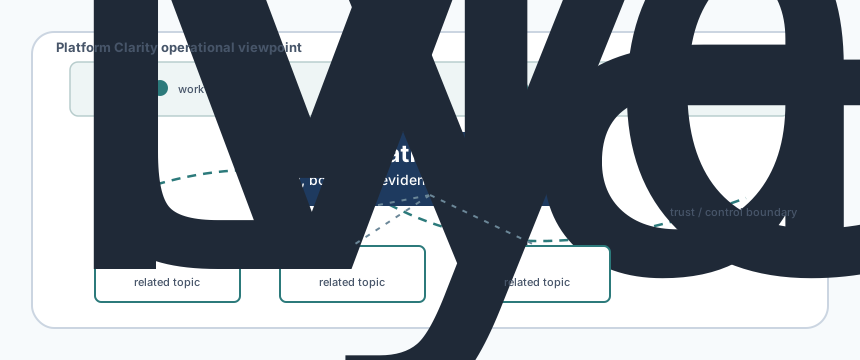
Visual pattern: Flow constraint map showing work movement, waiting states, decision points and feedback loops.
Introduction
Operational flow is how work, decisions, evidence and feedback move through an organisation. It is visible in lead times, queues, handovers, rework and the places where everyone waits.
Why It Exists
It exists as a concept because organisations often optimise components while the whole system remains slow, fragile or unclear.
Historical Context
Flow thinking draws from lean, systems thinking, DevOps and operations management. Its technology relevance increased as software became the means by which many organisations change.
Core Principles
- Look at the end-to-end system, not only local activity.
- Queues and handovers often reveal more than utilisation.
- Feedback speed affects decision quality.
- Flow must include governance and assurance, not bypass them.
Operational Interpretation
In operational terms, Operational Flow should change how people make decisions. It should influence review questions, design constraints, evidence expectations and escalation paths. If it only appears in policy documents, architecture packs or procurement questionnaires, it has not yet become part of the operating system of the organisation.
Common Misunderstandings
- Equating flow with speed alone.
- Treating governance as external to delivery flow.
- Ignoring cognitive load and decision queues.
Common Failure Modes
- Teams are busy but value waits in approvals.
- Work enters delivery faster than it can be validated.
- Manual evidence collection slows every release.
- Incident learning does not feed back into design.
Relationship To Other Frameworks
Operational Flow rarely stands alone. It connects to the surrounding operating model because platforms are made of governance, delivery, security, data, people and evidence. The related topics below should be read as neighbouring disciplines rather than optional extras.
Practical Organisational Examples
- A change process reduces lead time by moving security review earlier and automating evidence.
- A platform team finds release friction is caused by shared environment contention, not developer productivity.
- A governance board shifts from monthly approvals to lightweight decision thresholds.
Worked Scenario
A team complains that governance is slowing delivery. Governance replies that teams submit poor evidence too late. Both are partly right, which is why the argument repeats. The real problem is the flow of evidence through the system.
Mapping operational flow shows that architectural decisions, security evidence and release readiness are created after implementation rather than during it. The improvement is not to remove governance, but to move evidence creation earlier, automate parts of it and clarify decision thresholds before work is committed.
Governance Implications
Governance should understand its effect on flow and remove low-value delay while preserving necessary control.
Delivery/Engineering Implications
Engineering teams use flow to identify bottlenecks, batch size problems, dependencies and feedback gaps.
Architecture Implications
Architecture either enables flow through modularity and clear boundaries or damages it through coupling and hidden dependency.
Evidence And Implementation Notes
Operational flow is visible in queues, waiting time, rework, handovers, approval delay, incident interruption and unclear ownership. Review value streams, release calendars, change records, support queues, architecture review timings and manual evidence collection. The most useful data is often not sophisticated; it is simply where work waits and why.
Implementation should not confuse flow with removing control. In mature environments, assurance is designed into the path of work so that evidence is produced as a by-product of delivery. When governance sits outside the flow, teams either wait too long or bypass it.
The strongest operational-flow discussions include people from product, engineering, operations, security and governance. Each group can optimise locally while damaging the whole system. Flow makes those trade-offs visible.
Trade-offs And Tensions
Operational flow creates tension because improving the whole system may require individual teams to stop optimising their own utilisation. A team that appears fully busy can still be part of a slow system if its work creates queues, handovers or rework elsewhere.
There is also tension between speed and assurance. Removing every gate may improve apparent flow while increasing downstream risk. Keeping every gate may protect nobody if teams wait weeks for decisions that could have been designed into the work earlier. The mature design is not anti-governance; it makes governance flow-aware.
Flow also exposes leadership choices. If too much work enters the system, queues grow and priorities churn. Teams may look inefficient, but the constraint is demand management, not delivery discipline.
Implementation Pattern
Start with one value stream or decision path. Map the steps from request to outcome, including waiting time, approval, rework, evidence creation and handover. Mark where work waits and where people are unclear who can decide.
Then select one constraint to improve. Good first experiments include reducing batch size, moving review earlier, automating evidence, clarifying decision rights, reducing handovers or making operational readiness part of definition of done.
Review the effect after a short period. Flow improvement should be empirical. If the change reduces waiting but increases defects, the system has not improved; it has moved cost.
What To Measure
Measure total lead time, waiting time, rework, handoff count, work in progress, approval delay, blocked work, incident interruption and age of stale decisions. Include qualitative notes, because a number without cause can mislead.
One strong measure is “time in confidence gap”: how long work continues while a decision, risk or evidence question remains unresolved. Long confidence gaps are where delivery speed often becomes future rework.
When This Becomes Urgent
Operational flow becomes urgent when delivery effort is high but outcomes remain slow, fragile or unpredictable. Leaders may see busy teams, full backlogs and regular status reporting, yet customer value still moves slowly. That usually means the constraint sits in queues, handovers, unclear decisions or rework rather than individual effort.
The trigger is often a programme that appears to be progressing until integration, assurance or operational readiness exposes hidden delay. Flow work should begin before that point by mapping how evidence and decisions move, not only how code moves.
Review evidence should include value-stream maps, work-in-progress levels, approval waiting time, blocked-work logs, release records, incident interruption, rework patterns and decision age. The aim is to see where the operating system slows itself down.
The first practical move is to map one piece of work that recently felt slow or painful. Include the invisible steps: waiting, clarification, approval, rework, evidence collection and operational handover. The improvement opportunity is usually in those invisible steps rather than the formal process diagram.
Good flow work makes constraints discussable without blame. Instead of asking why a team is slow, it asks where work waits, why evidence arrives late, which decision is unclear and which handover creates rework. That distinction matters. People can defend themselves against blame, but they can usually collaborate around a visible constraint.
Flow should also include stopped work. Paused initiatives, half-approved decisions and unresolved dependencies consume attention even when they disappear from delivery reports. Reviewing dormant work often reveals hidden overload and strategic indecision.
Those quiet queues are often where the most expensive delay hides.
What Mature Organisations Do Differently
Mature organisations manage flow as a system property, measured with data and discussed without blame.
Where Smaller Organisations Should Simplify
Smaller organisations can start with a simple value-stream map and one improvement experiment per month.
Operational Review Questions
- What decision is Operational Flow meant to improve in this organisation?
- Which piece of evidence would show that it is working during normal delivery, not only during review?
- Where would teams work around it if deadlines compressed, an incident escalated or a supplier pushed back?
- Which exception would become dangerous if it quietly became normal practice?
- Which neighbouring topic changes the answer: DORA Metrics, Observability, Capability Mapping?
Signals To Look For
A useful review looks for behaviour, not only artefacts. The strongest signal is usually not whether Operational Flow is named in a policy, but whether it changes prioritisation, design, access, release, recovery or escalation. Look for repeated delays, unclear ownership, manual workarounds, unmanaged exceptions, untested assumptions and evidence that only appears when an audit or executive review is imminent.
The second signal is proportionality. Weak organisations either ignore the topic until something breaks or turn it into a heavy process that teams route around. Stronger organisations know where the topic matters most, where a lighter control is enough and where additional evidence is justified by risk.
Diagram Concept
The current topic diagram is a relationship map. A mature diagram for this page should show the operating boundary created by Operational Flow: the decision points, ownership handovers, evidence loops, escalation routes and related concepts that make the idea inspectable. The visual should help a leader ask better questions and help an engineer understand what changes in delivery.
Related Topics
Start with DORA Metrics, Observability, Capability Mapping. These relationships are deliberately practical: they show where this topic changes an adjacent architecture, governance or delivery conversation.
