
Quality systems
ISO 9001
ISO 9001 as a quality management system for feedback, correction and repeatable operational maturity.
Platform Clarity perspective
The operational reading
ISO 9001 is not about making every process heavy. Its operational value is making feedback, correction and repeatability visible enough that quality can improve before failure becomes normal.
Related operational concepts
- feedback loops
- process evidence
- corrective action
- repeatable delivery
- quality drift
Observable signals
- corrective action age
- recurring nonconformities
- handoff failure rate
- rework volume
- process exception rate
- customer-impact trend
When this becomes harmful
- quality becomes document production
- teams optimise for audit evidence
- corrective actions do not change flow
- lightweight work is forced into heavyweight procedure
Operational scenario
Quality procedures exist, yet the same handoff defects return every release. ISO 9001 review follows feedback loops, corrective action effectiveness and whether process evidence changes how work is actually done.
AI governance thread
AI-generated work needs quality loops too: review, correction, provenance and escalation when outputs influence customer, operational or regulated decisions.
Signals & failure patterns
What to look for before confidence becomes fragile.
These are not scorecards by themselves. They are review prompts: signs that flow, trust, governance or operational understanding may be degrading under pressure.
Failure patterns
- document production
- audit optimisation
- corrective actions without flow change
- heavyweight procedure for lightweight work
Pressure indicators
- corrective action age
- recurring nonconformities
- handoff failure rate
- rework volume
Confidence erosion
- quality evidence exists but repeated defects remain
- process adherence improves while customer-impact trend worsens
From theory to operating reality
What changes under pressure
ISO 9001 is operationally useful when feedback changes work. Under pressure, the test is whether correction, learning and repeatability improve before failure becomes normal.
Knowledge graph
Read this with the neighbouring disciplines.
Platform Clarity treats each topic as part of an operating model: controls change flow, flow creates evidence, evidence changes governance, and governance must survive delivery pressure.
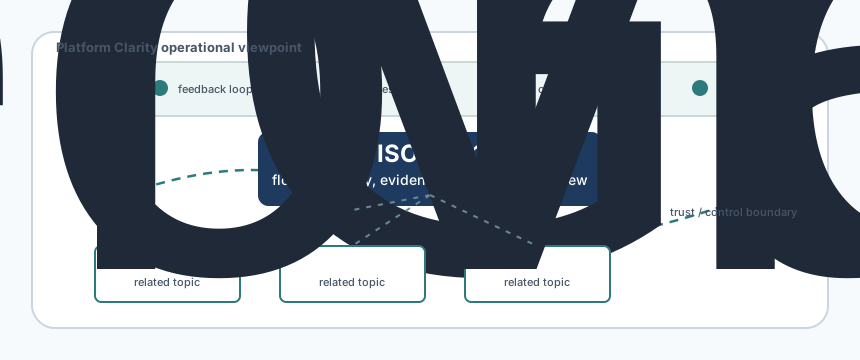
Visual pattern: Quality feedback loop showing process, evidence, nonconformity, correction and operational learning.
Introduction
ISO 9001 is a quality management standard. In operational architecture terms, its value is the discipline of understanding process, measuring performance, correcting failure and improving the system rather than relying on heroic effort.
Why It Exists
Organisations need quality to be repeatable. ISO 9001 exists because customers and leaders need confidence that outcomes are produced by a managed system, not by luck, individual memory or last-minute recovery.
Historical Context
Quality management has roots in manufacturing and process improvement, but ISO 9001 applies more widely. Its relevance to technology organisations is often underestimated because software teams may resist anything that smells like paperwork.
Core Principles
- Understand customer requirements and operational context.
- Define processes clearly enough to manage and improve them.
- Use evidence, nonconformity and corrective action to learn.
- Make improvement a management responsibility, not a side activity.
Operational Interpretation
In operational terms, ISO 9001 should change how people make decisions. It should influence review questions, design constraints, evidence expectations and escalation paths. If it only appears in policy documents, architecture packs or procurement questionnaires, it has not yet become part of the operating system of the organisation.
Common Misunderstandings
- Thinking ISO 9001 requires heavy bureaucracy.
- Treating quality as inspection at the end rather than capability throughout delivery.
- Ignoring service and platform operations because the language sounds manufacturing-oriented.
Common Failure Modes
- Process documents describe an ideal route nobody follows.
- Corrective actions close administratively but the root cause remains.
- Quality metrics exist but are not connected to customer or operational outcomes.
- Teams optimise local output while the end-to-end system stays brittle.
Relationship To Other Frameworks
ISO 9001 rarely stands alone. It connects to the surrounding operating model because platforms are made of governance, delivery, security, data, people and evidence. The related topics below should be read as neighbouring disciplines rather than optional extras.
Practical Organisational Examples
- A platform team uses quality management thinking to reduce repeated release defects by improving acceptance criteria, automated checks and handover evidence.
- A service organisation tracks recurring support failures as process nonconformities rather than blaming individual analysts.
- A transformation programme reviews why governance decisions are repeatedly reopened and treats unclear decision ownership as a quality failure.
Worked Scenario
A service team has a recurring problem: every month a small number of customer requests are mishandled, corrected manually and forgotten. The organisation calls them “one-offs”, but the pattern keeps returning. Without quality-system thinking, the team absorbs the pain as normal operational noise.
An ISO 9001 lens treats recurrence as evidence. The process is reviewed, failure points are identified, corrective action is assigned and management checks whether the change worked. The value is not the certificate. The value is that the organisation stops normalising avoidable rework.
Governance Implications
Governance should make quality visible through process ownership, management review, corrective actions and evidence of improvement. A useful quality system asks whether the organisation is learning from failure.
Delivery/Engineering Implications
Engineering teams benefit when quality management improves requirements, review loops, testing, release readiness and operational handover. It fails when imposed as detached documentation.
Architecture Implications
Architecture quality appears in repeatable patterns, reusable controls, clear boundaries and maintainable operational processes. ISO 9001 thinking helps expose where architecture work depends too heavily on individual memory.
Evidence And Implementation Notes
ISO 9001 is useful in platform work when it makes recurring failure visible. Look for nonconformities, corrective actions, defect trends, customer feedback, internal audit findings and management review decisions. The point is not to prove that a process exists. The point is to show that the organisation notices when the process fails and improves it deliberately.
In technology environments, quality often hides inside delivery friction: unclear requirements, repeated release defects, handover gaps, weak acceptance criteria, fragile support processes and decisions that are reopened because they were never properly recorded. These are quality-system signals even if nobody labels them as ISO 9001.
The mature move is to treat quality as a feedback loop. A process that never changes may be documented, but it is not learning.
Trade-offs And Tensions
ISO 9001 can be misunderstood as bureaucracy because organisations sometimes implement it as document control rather than quality learning. The useful tension is between repeatability and adaptability. A process should be stable enough that outcomes can be understood, but not so rigid that teams cannot improve it when evidence shows a better route.
There is also tension between customer quality and internal convenience. A process may be easy for the organisation but poor for the customer, or efficient for one team but damaging to the end-to-end service. ISO 9001 thinking should force the organisation to look at quality from the outside in.
In platform environments, quality is often distributed. Requirements quality, engineering quality, operational handover, support quality and governance quality all interact. Treating quality as a single department’s responsibility misses the system nature of the problem.
Implementation Pattern
Start by identifying the processes that most affect customer outcomes or operational confidence. For a platform organisation, that may include service onboarding, change release, incident handling, supplier support, access request, data correction or customer escalation.
Define the intended process, the evidence it produces and what counts as failure. Then create a corrective-action loop that is lightweight enough to use regularly. The organisation should know when a process failed, why it failed, what changed and whether the change worked.
Connect quality review to leadership decisions. If repeated defects require investment in tooling, training, capacity or architecture change, the management system should make that visible rather than leaving teams to absorb the cost quietly.
What To Measure
Useful measures include repeated defects, rework, customer complaints, escaped issues, incident recurrence, corrective-action age, audit findings, process exceptions and handover failures. The pattern matters more than any single number.
Quality measures should be discussed with context. An increase in reported nonconformities may indicate deterioration, but it may also show that teams are finally reporting problems honestly. The mature question is whether learning and corrective action follow.
When This Becomes Urgent
ISO 9001 thinking becomes urgent when repeated problems are being treated as isolated incidents. In platform and service environments, that might look like recurring release defects, repeated support escalations, inconsistent onboarding, missed handovers or customer complaints that are corrected one by one without changing the system.
The trigger is recurrence. If the same class of issue returns, the organisation needs a quality loop rather than more individual effort. This is where ISO 9001 is useful beyond certification: it gives leaders a way to ask whether processes are defined, measured, corrected and improved.
Review evidence should include customer feedback, nonconformity records, corrective actions, process ownership, internal audit findings, management review decisions and trend data. A mature quality system can show not only what went wrong, but what changed because it went wrong.
What Mature Organisations Do Differently
Mature organisations connect quality management to incident learning, delivery flow, customer outcomes and operational metrics. They treat repeated friction as system evidence.
Where Smaller Organisations Should Simplify
Smaller organisations should start with lightweight process ownership, defect review, customer feedback, corrective actions and a monthly improvement rhythm.
Operational Review Questions
- What decision is ISO 9001 meant to improve in this organisation?
- Which piece of evidence would show that it is working during normal delivery, not only during review?
- Where would teams work around it if deadlines compressed, an incident escalated or a supplier pushed back?
- Which exception would become dangerous if it quietly became normal practice?
- Which neighbouring topic changes the answer: Operational Governance, Operational Flow, Observability?
Signals To Look For
A useful review looks for behaviour, not only artefacts. The strongest signal is usually not whether ISO 9001 is named in a policy, but whether it changes prioritisation, design, access, release, recovery or escalation. Look for repeated delays, unclear ownership, manual workarounds, unmanaged exceptions, untested assumptions and evidence that only appears when an audit or executive review is imminent.
The second signal is proportionality. Weak organisations either ignore the topic until something breaks or turn it into a heavy process that teams route around. Stronger organisations know where the topic matters most, where a lighter control is enough and where additional evidence is justified by risk.
Diagram Concept
The current topic diagram is a relationship map. A mature diagram for this page should show the operating boundary created by ISO 9001: the decision points, ownership handovers, evidence loops, escalation routes and related concepts that make the idea inspectable. The visual should help a leader ask better questions and help an engineer understand what changes in delivery.
Related Topics
Start with Operational Governance, Operational Flow, Observability. These relationships are deliberately practical: they show where this topic changes an adjacent architecture, governance or delivery conversation.
