
Architecture control
Transition Architecture
Transition architecture as the governed operating state between legacy systems and target platforms.
Platform Clarity perspective
The operational reading
Transition architecture is mature when the temporary state is visible, owned, measured and actively retired rather than allowed to become the new permanent platform.
Related operational concepts
- temporary hybrid state
- strangler migration
- coexistence risk
- decommissioning
- duplicated operations
- migration governance
Observable signals
- retired capability count
- duplicate run cost
- synchronisation failures
- legacy dependency count
- coexistence duration
- decommissioning progress
- transition exception age
When this becomes harmful
- the temporary hybrid becomes permanent
- migration progress is measured by new services added rather than old complexity removed
- duplicated operations become normal
Operational scenario
A strangler-pattern migration replaces parts of a legacy platform, but the organisation keeps the old system, new services, synchronisation jobs, duplicated monitoring and unclear ownership running for years.
AI governance thread
AI-assisted modernisation can accelerate code extraction and service creation, but without transition governance it may also create faster fragmentation, weaker ownership and more opaque duplicated logic.
Signals & failure patterns
What to look for before confidence becomes fragile.
These are not scorecards by themselves. They are review prompts: signs that flow, trust, governance or operational understanding may be degrading under pressure.
Failure patterns
- distributed legacy
- permanent coexistence
- duplicated operations
- unclear ownership
- synchronisation treated as plumbing
Pressure indicators
- coexistence duration grows
- transition exceptions age
- decommissioning backlog stalls
- duplicate run cost rises
- legacy dependencies stay invisible
Confidence erosion
- teams cannot explain which system is authoritative
- operational dashboards disagree
- ownership is split across old and new paths
- retirement gates are repeatedly deferred
From theory to operating reality
What changes under pressure
Transition architecture turns modernisation from a target-state story into a governed operating state. Under pressure, the question is not only what is being built; it is what is being retired, who owns the overlap and what evidence proves the hybrid state remains safe.
Knowledge graph
Read this with the neighbouring disciplines.
Platform Clarity treats each topic as part of an operating model: controls change flow, flow creates evidence, evidence changes governance, and governance must survive delivery pressure.
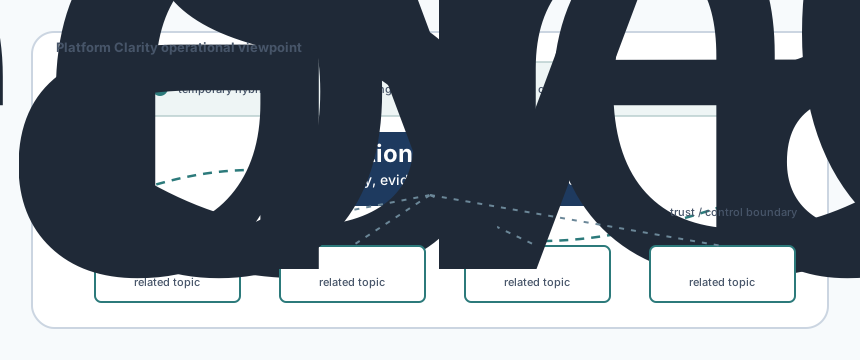
Visual pattern: Transition-state map showing old system, new services, synchronisation paths, ownership boundaries, retirement gates and operational evidence.
Introduction
Transition architecture is the architecture of the temporary state between what exists now and what the organisation is trying to become. It covers phased replacement, migration, parallel running, strangler-pattern adoption, platform consolidation, coexistence and decommissioning.
It is not only a bridge between old and new systems. During the transition, it is the live operating model. Users depend on it. Support teams diagnose it. Data moves through it. Monitoring must explain it. Governance must make decisions about it. Costs accumulate around it.
That matters because many modernisation programmes describe the target platform carefully while treating the transition state as an implementation detail. The result can be distributed legacy: the old system remains, new services appear, synchronisation logic grows, deployment paths duplicate, dashboards disagree and ownership becomes unclear.
Why It Exists
Transition architecture exists because most real modernisation cannot happen in a single cutover. Organisations usually need to protect live service, reduce delivery risk, learn from incremental replacement and avoid freezing business change while the target state is built.
A strangler-pattern migration can be a good choice. It allows parts of a legacy platform to be replaced gradually while the existing system continues to serve users. The risk is not the pattern itself. The risk is failing to govern the coexistence state that the pattern creates.
The transition state must be designed, not merely tolerated. It needs decision rights, operating evidence, funding, ownership, retirement gates and a clear answer to what disappears next.
Historical Context
Architecture has long distinguished between current state, transition states and target state. Enterprise architecture frameworks often use transition architectures to describe interim capability, system and organisational arrangements on the path to a future architecture.
Modern software delivery gave this older idea sharper operational consequences. Continuous delivery, API-led integration, data platforms, cloud migration and strangler-style legacy replacement all made incremental change more practical. They also made it easier to accumulate half-retired platforms and duplicated operating paths.
The historical mistake is to think that incremental replacement removes the need for transition governance. In practice it increases the need for it, because the organisation may run old, new and bridging architecture at the same time.
Core Principles
- Treat the transition state as production architecture.
- Make system-of-record decisions explicit during coexistence.
- Govern synchronisation logic as critical platform behaviour.
- Measure complexity removed, not only new capability delivered.
- Fund and own decommissioning from the start.
- Define retirement gates before the bridge becomes normal.
- Keep observability across old systems, new services and the paths between them.
- Make ownership boundaries visible while responsibilities are moving.
Operational Interpretation
Operationally, transition architecture is about keeping a hybrid state safe, explainable and temporary. It should change how teams plan releases, design monitoring, handle incidents, assess risk and decide whether a migration is genuinely progressing.
The operating question is not simply whether a new service works. It is whether the organisation can explain how the old system, new service, integration bridge, data synchronisation, support route, access model, reporting path and decommissioning plan fit together.
If those elements are not explicit, modernisation can increase complexity while appearing to progress. Teams may deliver new services but retain the old operational burden. The organisation sees activity and new capability, but the platform becomes harder to understand.
Common Misunderstandings
- Treating transition architecture as a project plan rather than a live operating state.
- Assuming the strangler pattern automatically reduces legacy risk.
- Calling synchronisation jobs temporary plumbing when they are carrying production truth.
- Measuring progress by services created without measuring responsibility retired.
- Believing decommissioning can be handled after delivery finishes.
- Assuming target-state diagrams are enough to govern the messy middle.
- Ignoring support, reporting, access and monitoring paths because they are not part of the new product architecture.
Common Failure Modes
- The old system remains the real system of record while new services become expensive facades.
- Synchronisation failures create inconsistent data and unclear accountability.
- New and old systems have separate monitoring, making incidents harder to diagnose.
- Product teams own new services while operations still owns the old platform and nobody owns the bridge.
- Decommissioning has no funding, no senior owner and no acceptance criteria.
- Shared databases preserve hidden coupling after the service boundary appears to have changed.
- Reporting, batch jobs and manual workarounds keep legacy behaviour alive.
- Security and access models diverge across old and new paths.
Relationship To Other Frameworks
Transition Architecture rarely stands alone. It connects to Architectural Segmentation because boundaries must be meaningful during coexistence, not only after the target state is complete.
It connects to Operational Flow because migration work includes waiting states, unresolved decisions, decommissioning backlog, support handover and evidence creation. If flow only measures new delivery, it misses half the transition.
It connects to Observability because both sides of the transition and the bridge between them must be visible. It connects to Operational Governance because exceptions, retirement gates and ownership transfers need decisions that survive delivery pressure.
It also connects to Capability Mapping because migration should retire or consolidate real organisational capability, not just move code from one place to another.
Practical Organisational Examples
- A customer platform moves account preferences from a monolith to a new profile service, but reporting still reads from the old database. Transition architecture makes the reporting dependency visible and assigns a retirement gate.
- A cloud migration moves application runtime before batch processing, monitoring and support tooling are ready. The transition map shows the remaining on-premises dependencies rather than pretending migration is complete.
- A payment platform replaces checkout orchestration incrementally. The architecture identifies which service is authoritative for each payment state during coexistence.
- A data platform introduces new event streams while legacy extracts continue. The transition state defines reconciliation, duplicate reporting risk and the date by which legacy extracts should disappear.
- A public service replaces one user journey at a time while call-centre processes remain tied to the old system. The transition plan includes support scripts, training and operational ownership.
Worked Scenario
A business starts a strangler-pattern migration around a legacy case-management platform. The first increments are sensible. A new service handles document upload. Another service handles notifications. A third service handles status tracking. The legacy system remains in place for case decisions and historical reporting.
At first this reduces risk. Teams can deliver value without rewriting the whole platform. Users see improvements. The migration has working software and sensible increments.
After two years, the transition state has become harder to explain. The old system still owns key data. New services have their own deployment paths. Synchronisation jobs copy records between old and new stores. Monitoring is split. Support teams check three dashboards. Reporting uses legacy extracts because the new data model is not complete. Product owns the new services, operations owns the old system and a project team owns the bridge.
Nothing here proves the original migration pattern was wrong. The failure is that the temporary state was not actively governed. The organisation measured what was added, but not what disappeared.
A transition architecture review would ask what the next retirement event is, which system is authoritative for each capability, what synchronisation failure would look like, who owns incidents across the bridge, what duplicate run cost is being carried and which evidence proves decommissioning is moving.
Governance Implications
Governance should treat transition as a state with controls, not as a narrative between two diagrams. It should ask what disappears next, what risk exists while old and new coexist, and what decision would allow a piece of legacy responsibility to be retired.
Governance should also prevent indefinite exception handling. Long transitions can be legitimate, especially in regulated, high-volume or high-risk environments. They become weak when exceptions have no expiry, coexistence has no owner and decommissioning is always deferred behind new feature work.
Good governance asks for retirement gates, evidence thresholds, ownership transfer plans, cost visibility, operational readiness and a live map of remaining dependencies.
Delivery/Engineering Implications
Engineering teams need to treat transition mechanisms as first-class production components. Synchronisation jobs, adapters, routing rules, database views, event translators, batch bridges and reconciliation scripts are not incidental. They are part of the operating architecture.
Delivery plans should include decommissioning work items, not only build work. They should include rollback and fallback paths for the transition state, not only the target service. They should also include tests that prove old and new behaviours remain consistent while coexistence is still required.
A useful engineering question is: if this bridge fails at 03:00, who knows, who owns it and which user or business process is affected?
Architecture Implications
Architecture should show the temporary hybrid explicitly. The diagram should include old system, new services, synchronisation paths, data ownership, access models, reporting flows, operational monitoring, support routes and retirement gates.
Hidden coupling often sits outside the obvious service boundary. Shared databases, reporting extracts, batch jobs, access models, monitoring dashboards, support scripts and operational runbooks can preserve legacy dependency after the code path appears modernised.
Segmentation should make boundaries meaningful during the transition. If the old platform and new services share uncontrolled data stores, unmanaged credentials or ambiguous ownership, the target architecture boundary is not yet operationally real.
Evidence And Implementation Notes
Useful evidence includes dependency maps, system-of-record decisions, interface inventories, synchronisation logs, reconciliation reports, incident records, support routes, duplicate monitoring lists, cost reports, decommissioning backlog and retirement acceptance criteria.
Implementation should begin by naming the transition state. Give it an owner, an operating map and measures. Identify which capabilities are still served by legacy, which have moved, which are duplicated and which are bridged.
For every new service introduced, record the legacy responsibility it is expected to replace. If nothing is expected to disappear, the work may still be valuable, but it should not be described as legacy reduction.
Trade-offs And Tensions
Short transitions can reduce operating cost but increase cutover risk. Long transitions can reduce delivery risk but create duplicate cost, blurred ownership and synchronisation complexity. Neither is automatically correct.
The tension is between safe incremental change and permanent coexistence. A mature transition may last years if the organisation is explicit about risk, cost, ownership and retirement. An immature transition can become dangerous in months if nobody owns the hybrid state.
There is also tension between feature delivery and decommissioning. New services are visible. Retired dependencies are less visible but often more valuable. Leadership has to make complexity removal a funded outcome, otherwise teams will optimise for what can be demonstrated rather than what reduces operational burden.
Implementation Pattern
Start with a transition-state map. Show current system, target services, data movement, synchronisation paths, reporting dependencies, access models, monitoring, support routes and ownership boundaries.
Then classify each element as retained, replaced, duplicated, bridged or retired. For duplicated and bridged elements, define a retirement gate: the evidence required before the old responsibility can disappear.
Next, add operating measures. Track duplicate run cost, synchronisation failures, coexistence duration, decommissioning backlog, unresolved ownership decisions and remaining legacy dependency count.
Finally, review the map at a regular cadence. The central governance question should be simple: what disappears next?
What To Measure
Measure retired capability count, duplicate run cost, synchronisation failures, legacy dependency count, coexistence duration, decommissioning progress, transition exception age, unresolved ownership decisions, duplicate monitoring count and incident diagnosis time across old/new boundaries.
Measure both build and retirement. A migration that adds ten new services while retiring no legacy responsibility may be increasing platform surface area rather than reducing it.
Also measure the confidence gap: how long the organisation continues to operate while system-of-record, ownership, monitoring or decommissioning questions remain unresolved.
When This Becomes Urgent
Transition architecture becomes urgent when the organisation can no longer explain the hybrid state quickly. Warning signs include incidents that require multiple teams to reconstruct the path, reports that disagree depending on which system produced them, old and new dashboards showing different truths, and migration status reporting that focuses only on new services delivered.
It is also urgent when duplicate run cost starts to look normal. Parallel running can be necessary, but it should remain visible. Once duplicated operations become part of the baseline, the organisation may stop treating decommissioning as part of the programme.
The most important trigger is usually ownership ambiguity. If the old system, new services and bridge are owned by different groups with no single accountable operating view, the transition state has become its own platform without being governed as one.
What Mature Organisations Do Differently
Mature organisations treat the transition state as a designed operating model. They can explain which capabilities are old, new, duplicated, bridged and retired. They know which system is authoritative for each business concept during coexistence.
They measure complexity removed. They fund decommissioning. They monitor the bridge. They expire exceptions. They keep ownership clear even while responsibility moves. They do not confuse target-state ambition with current-state control.
Most importantly, they make retirement visible. They can show not only what has been built, but what has been safely switched off.
Where Smaller Organisations Should Simplify
Smaller organisations do not need a heavy transition architecture office. They need a clear map, a named owner and a short list of retirement decisions.
A practical lightweight approach is to keep one page showing old components, new components, bridges, owners, known risks and next retirement event. Review it every two weeks while the migration is active. If the page stops changing, the transition may be becoming permanent.
Small teams should be careful with synchronisation. A simple manual reconciliation may be safer than building a complex bridge too early, provided the risk and effort are understood. The aim is not elegance. The aim is a transition state that remains visible, owned and reversible.
Operational Review Questions
- What is the named transition state and who owns it?
- Which capabilities are retained, replaced, duplicated, bridged or retired?
- Which system is authoritative for each key business concept during coexistence?
- What synchronisation logic exists, how is it monitored and who owns failure?
- What is the next legacy responsibility expected to disappear?
- Which retirement gates are defined and what evidence is required to pass them?
- What duplicate run cost is being carried and who sees it?
- Where do support, reporting, access and monitoring still depend on the old system?
- Which neighbouring topic changes the answer: Architectural Segmentation, Operational Flow, Observability, Operational Governance, Capability Mapping?
Signals To Look For
A useful review looks for the behaviour of the hybrid state, not only the migration plan. Look for old and new systems both claiming ownership, synchronisation jobs without product ownership, unresolved system-of-record decisions, duplicate monitoring, manual reconciliation, reporting extracts that preserve legacy dependency and decommissioning work repeatedly pushed behind new capability.
The strongest signal is whether retirement is happening. If the programme can show new services but cannot show old responsibility removed, the organisation may be modernising the surface while preserving the operating burden.
Also look for language. If teams describe transition components as temporary but cannot name the retirement condition, the temporary state is already at risk of becoming permanent.
Diagram Concept
The diagram should be a transition-state map. It should show the old system, new services, synchronisation paths, ownership boundaries, retirement gates and operational evidence.
The useful visual is not a clean before-and-after comparison. It is the messy middle made inspectable: where data moves, where responsibility changes, where monitoring must cover both sides and where decommissioning decisions sit.
Related Topics
Start with Architectural Segmentation, Operational Flow, Observability, Operational Governance and Capability Mapping. These relationships are deliberately practical: they show where transition architecture changes adjacent architecture, governance and delivery conversations.
Further Reading
- Martin Fowler: Strangler Fig Application
- Thoughtworks: Building Evolutionary Architectures
- DORA value stream mapping for software delivery
- DORA software delivery performance metrics
- GOV.UK Service Manual: how the live phase works
- GOV.UK Service Manual: retiring your service
- Platform Clarity topics: Architectural Segmentation, Operational Flow, Observability, Operational Governance, Capability Mapping
