
Pillar article and assessment framework
Enterprise Debt: The Hidden Cost of Accumulated Complexity
Technical debt is only one form of debt. Organisations also accumulate process debt, governance debt, policy debt and organisational debt that quietly reduce agility, increase cost and slow delivery.
1. Introduction
Most technology leaders understand technical debt. They recognise duplicated code, brittle integrations, outdated platforms and shortcuts that seemed sensible at the time but later become expensive.
The same pattern exists across the wider organisation. It appears in data definitions that nobody trusts, governance forums that no longer make decisions, processes that contain inherited approvals, policies that are older than the systems they govern, spreadsheets that became operational infrastructure, and organisational structures that preserve old accountability long after the work has moved elsewhere.
Processes accumulate approvals nobody can justify. Governance forums continue after their purpose has disappeared. Reports are produced because they have always been produced. Policies remain long after the risks, systems or regulations that created them have changed. Committees meet, forms are completed and decisions are escalated because removing them feels riskier than keeping them.
We often call it bureaucracy. We occasionally blame culture. In reality, these are often symptoms of debt.
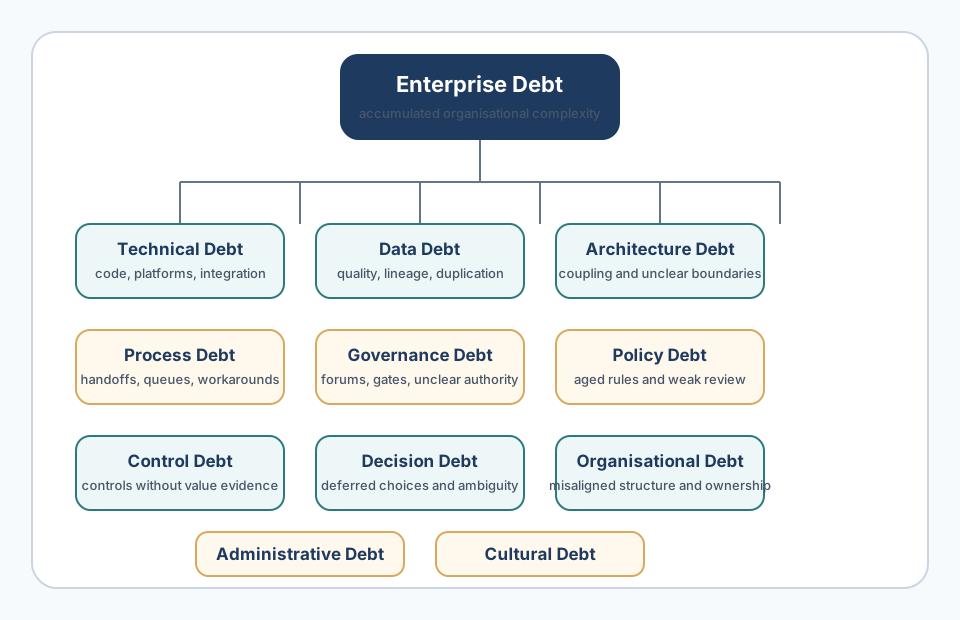
Technical debt is merely the technology manifestation of a wider phenomenon. Every organisation accumulates debt. Some of it sits in software. Some of it sits in data. Some of it sits in architecture. Much of it sits in process, governance, policy and organisational structures. Collectively these form Enterprise Debt.
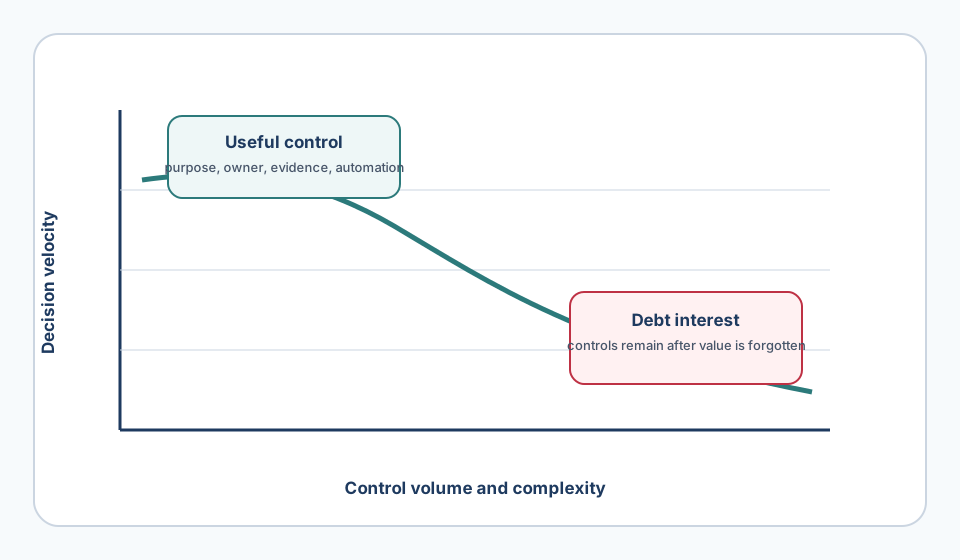
This matters because many organisations misread complexity as maturity. A long policy library, a full committee structure, multiple approval paths, duplicated controls and extensive reporting packs can create the appearance of governance. But if those controls no longer create value, the organisation is paying interest. Delivery slows. Costs rise. Teams lose trust. Innovation moves around the official path. Decision-making becomes theatre.
Debt is not always bad. Sometimes it is a deliberate trade-off: a short-term compromise made to meet a deadline, reduce a genuine risk, keep a public service running, or stabilise a critical supplier transition. The problem is unmanaged debt and compounding interest.
Enterprise Debt is not an argument for removing control. Public sector bodies, regulated organisations, utilities, financial services firms, defence environments, universities, housing associations and large outsourced services need strong governance. The question is whether the governance remains purposeful, owned, measured and proportionate to the risk it claims to manage.
2. What Is Enterprise Debt?
Enterprise Debt is the accumulated cost of decisions, structures, processes and controls that once solved a problem but whose ongoing cost now exceeds their continuing value.
The original decision may have been sensible. The context changes. The control, process or structure remains. The organisation continues paying the cost. Eventually, the cost exceeds the value.
The organisation remembers the behaviour but forgets the reason.
3. The Enterprise Debt model
Enterprise Debt is the accumulated friction created when technology, data, architecture, process, governance, policy, control, decision and organisational structures continue to exist after their original context has changed.
The useful question is not simply: what is broken? Many debt-laden organisations still work. The better question is: how much unnecessary effort is required to keep working, and how much confidence is being assumed rather than evidenced?
| Debt domain | What it tends to hide | Common consequence |
|---|---|---|
| Technical and architecture debt | Old dependencies, fragile integration, unclear platform boundaries. | Higher change cost and lower confidence under pressure. |
| Data debt | Duplicate definitions, poor lineage, weak ownership and manual reconciliation. | Decision friction and reporting distrust. |
| Process and administrative debt | Legacy handoffs, forms, meetings and manual workarounds. | Delay that nobody owns. |
| Governance, policy and control debt | Controls that remain after purpose, owner or evidence has disappeared. | Bureaucracy mistaken for assurance. |
| Decision, organisational and cultural debt | Deferred choices, unclear authority and behaviours that protect local comfort. | Slow delivery and weak accountability. |
4. Debt type catalogue
The categories below are deliberately practical. They are intended for review conversations, architecture assessments and operating model diagnostics, not taxonomy debates.
| Debt type | Definition | Typical causes | Symptoms and interest paid | UK-centric examples | Remediation approaches |
|---|---|---|---|---|---|
| Technical Debt | Accumulated implementation compromises in code, infrastructure, platforms and integrations. | Deadline pressure, unsupported components, rushed releases, tactical fixes. | Slow change, fragile releases, high support load, duplicated engineering effort. | An NHS integration service kept alive because downstream reporting still depends on it; a university portal with unsupported libraries; an outsourced service with undocumented scripts. | Prioritised remediation backlog, dependency upgrades, refactoring linked to delivery outcomes, retirement plans and platform ownership. |
| Data Debt | Weakness in data quality, ownership, lineage, classification and consistency. | Local spreadsheets, merged datasets, reporting demands, legacy migration shortcuts. | Manual reconciliation, multiple versions of truth, low trust in dashboards, repeated data cleansing. | Local authority services maintaining separate resident records; housing associations reconciling repairs, assets and tenancy data; utilities aligning asset registers after outsourcing changes. | Data ownership, lineage mapping, rationalised definitions, quality controls, master data decisions and removal of duplicate stores. |
| Architecture Debt | Structural complexity caused by unclear boundaries, excessive coupling and poorly governed platform evolution. | Incremental integration, acquisition, vendor constraints, unclear target architecture. | Change collisions, unknown blast radius, difficult decommissioning, high dependency concentration. | Central government platforms with overlapping case management systems; defence programmes with parallel legacy and modern environments; financial services estates with multiple integration layers. | Capability mapping, dependency analysis, transition architecture, segmentation, retirement gates and architecture decision records. |
| Process Debt | Steps, handoffs and queues that remain after the operating need has changed. | Incidents, local optimisation, manual controls, workarounds becoming standard practice. | Waiting time, repeated re-keying, unclear status, escalation as normal operating method. | Local authority change approvals involving teams no longer affected; NHS operational reporting chains built for an old performance regime. | Value stream mapping, removal of handoffs, automation, process ownership and explicit review of waiting states. |
| Governance Debt | Decision structures that no longer provide clear, timely or evidence-led governance. | Programme growth, audit reactions, leadership changes, risk avoidance. | Committees without authority, duplicated boards, unclear escalation routes, approval latency. | Programme boards reviewing architecture after implementation has already started; outsourced contract governance focused on pack production rather than decision quality. | Forum rationalisation, decision rights, evidence standards, meeting retirement and governance queue metrics. |
| Administrative Debt | Forms, templates, reporting packs and manual administration that consume time without clear value. | Legacy reporting, compliance responses, copied templates, spreadsheet control habits. | Meeting preparation overhead, duplicated status updates, low-value administration and employee frustration. | Universities maintaining multiple project reporting formats; housing providers producing reports with no named consumer. | Report inventory, consumer confirmation, form removal, template consolidation and automation where evidence is still required. |
| Policy Debt | Policies that are outdated, overlapping, contradictory or disconnected from operating reality. | Regulatory updates, inherited policy libraries, mergers, ownership gaps. | Policy avoidance, inconsistent interpretation, audit findings and local exceptions. | Financial services policies referencing retired systems; public sector policies copied across departments without local interpretation. | Policy ownership, expiry dates, plain-English review, policy-to-control mapping and retirement of superseded documents. |
| Control Debt | Controls that persist without evidence that they still reduce risk or improve outcomes. | Audit findings, incidents, regulator pressure, assurance anxiety. | Controls become ritual, exception handling grows, teams comply performatively. | Manual sign-offs retained after automated deployment controls exist; access reviews performed but not acted upon. | Control lifecycle management, success criteria, review dates, retirement criteria and control automation. |
| Decision Debt | Cost created by deferred, ambiguous or repeatedly reopened decisions. | Political sensitivity, unclear authority, fear of wrong choices, fragmented ownership. | Rework, architecture drift, unresolved exceptions, programmes waiting for permission. | Platform consolidation decisions delayed across departments; utilities delaying asset data ownership choices during transformation. | Decision logs, decision owners, reversible/irreversible classification, escalation paths and time-boxed options analysis. |
| Organisational Debt | Structural misalignment between teams, capabilities, accountability and operating reality. | Reorganisations, outsourcing, acquisitions, inherited structures, unclear product ownership. | Cross-team dependency load, duplicated capability, nobody owns end-to-end outcomes. | NHS or local authority digital teams accountable for journeys but not the legacy services underneath; large suppliers owning components without business outcome accountability. | Operating model redesign, capability ownership, product/platform boundaries and clear service accountability. |
| Cultural Debt | Habits that protect comfort, hierarchy or local safety while reducing enterprise learning and delivery confidence. | Blame culture, repeated failed change, leadership churn, fear of escalation. | Bad news travels slowly, risks are softened, challenge becomes unsafe, workarounds become normal. | Programme teams reporting green until late failure; delivery teams avoiding governance because it is perceived as punishment rather than help. | Psychological safety, blameless review, evidence-led governance, better escalation design and leadership consistency. |
5. How Enterprise Debt accumulates
Most Enterprise Debt begins as a reasonable response to a real concern. An incident happens. An audit finding lands. A regulator asks a difficult question. A leadership team changes. A supplier transition creates uncertainty. A programme deadline forces a workaround. A merger or acquisition brings inherited controls. A new reporting demand appears. A team adds a temporary workaround because nobody trusts the source data yet, and fear of removing controls becomes stronger than evidence that the control still works.
The first control may be sensible. The debt appears when the organisation never returns to ask whether the control still works, whether the context has changed, whether the risk has moved, or whether the cost now exceeds the value.
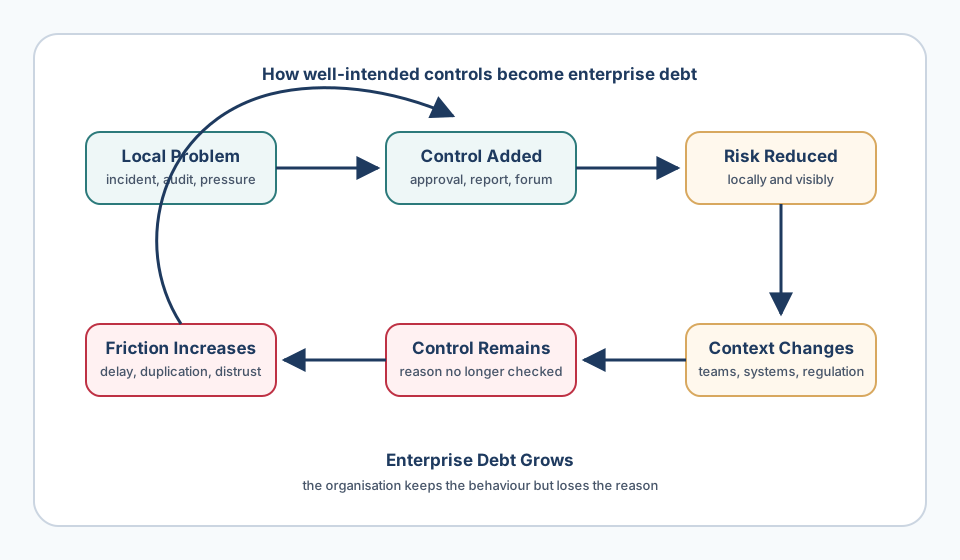
Enterprise Debt is therefore not mainly a stupidity problem. It is a memory problem, an ownership problem and a review problem. The organisation remembers the behaviour but forgets the reason.
6. The cost of debt interest
Debt interest is the recurring cost paid because the organisation carries complexity it no longer needs or cannot explain. The cost is rarely visible in one budget line. It appears as thousands of small frictions: additional approval time, meeting hours, manual reporting effort, duplicate data maintenance, delayed decision-making, longer delivery cycles, reduced innovation, reduced trust, employee frustration, higher operational cost and slower response to change.
| Interest payment | How it compounds | Evidence to inspect |
|---|---|---|
| Additional approval time | Small waits turn into delivery lead-time growth and decision fatigue. | Average approvals per change, approval latency, rework after late challenge. |
| Meeting hours | Status reporting consumes the time needed to resolve the issue being reported. | Forum calendar, attendance lists, decisions made per meeting. |
| Manual reporting effort | Teams maintain reporting packs because source systems are not trusted. | Preparation time, duplicated data entry, report consumers. |
| Duplicate data maintenance | Different teams optimise their own dataset and create reconciliation work elsewhere. | Duplicate datasets, reconciliation spreadsheets, data defects. |
| Delayed decision-making | Unclear authority forces escalation, rework and informal bypasses. | Decision logs, unresolved decision age, repeated agenda items. |
| Employee frustration | People stop trusting official pathways and create shadow processes. | Workarounds, attrition signals, engagement feedback, exception requests. |
7. The forgotten control problem
Inherited controls are one of the clearest signs of Enterprise Debt. They look normal because people have learned the behaviour. They are difficult to challenge because nobody wants to be the person who removes a control and later faces an incident. So the control survives.
Common examples include reports nobody reads, committees nobody can justify, approvals nobody owns, policies nobody reviews, forms nobody understands, dashboards nobody uses and risk controls that no longer map to the risk. In many organisations the control has become socially safer than the question. Asking “why do we still do this?” can feel more dangerous than continuing to pay the cost.
This is especially visible in public sector and regulated environments, where scrutiny is high and tolerance for visible failure is low. The answer is not reckless simplification. The answer is evidence-led challenge: identify the owner, restate the purpose, test whether the control still reduces risk, measure its cost and decide whether to renew, simplify, automate or retire it.
8. Measuring Enterprise Debt
Enterprise Debt cannot be measured perfectly. It can, however, be assessed well enough to guide a 90-minute review, prioritise deeper investigation and start useful executive conversations.
Use a five-point score for each dimension: 1 = Healthy, 2 = Emerging, 3 = Concerning, 4 = Significant, 5 = Critical. The score is less important than the evidence and disagreement behind it.
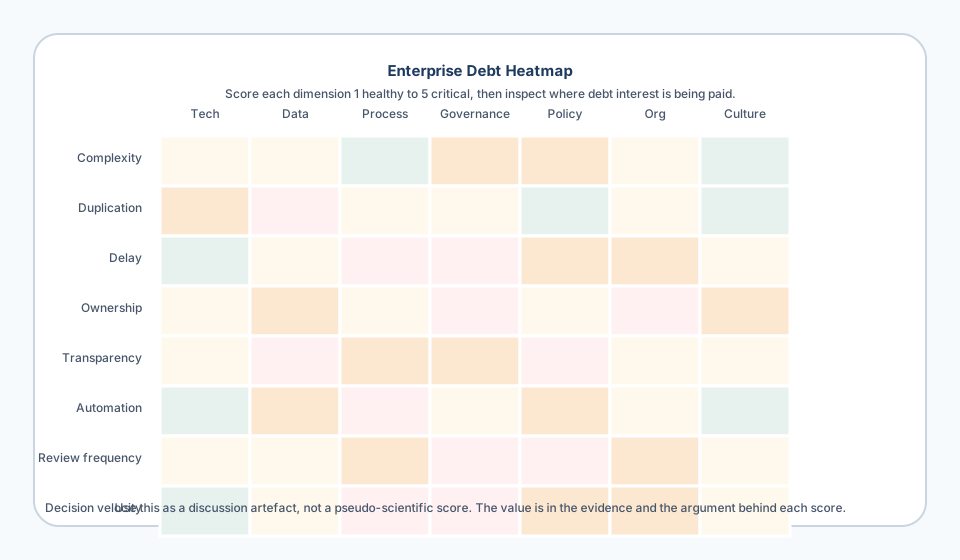
| Dimension | Review question | Evidence to collect | Scoring prompt |
|---|---|---|---|
| Complexity | How difficult is the operating model to explain? | Process maps, system maps, governance routes, exception paths. | Score higher when only a few experienced people can explain how work really moves. |
| Duplication | Where do teams maintain overlapping data, controls, reports or capabilities? | System inventory, report catalogue, forums, data ownership. | Score higher when duplicate artefacts are treated as necessary rather than transitional. |
| Delay | Where does work wait? | Approval timestamps, queue depth, meeting cadence, handoff records. | Score higher when delay is accepted as normal but not measured. |
| Ownership | Who can change, retire or defend each control? | RACI, service ownership, policy owners, forum terms of reference. | Score higher when ownership is implicit, inherited or contested. |
| Transparency | Can teams see why a process, policy or control exists? | Decision records, policy rationale, control mapping, audit trails. | Score higher when people follow rules without understanding their purpose. |
| Automation | Where is manual effort preserving a control that could be automated or removed? | Spreadsheets, manual checks, reporting preparation, re-keying. | Score higher when manual work compensates for weak systems or unclear decisions. |
| Review frequency | How often are controls challenged? | Review dates, policy age, committee review records, retired artefacts. | Score higher when renewal is assumed and retirement is rare. |
| Decision velocity | How quickly can a material decision be made with appropriate evidence? | Decision logs, escalation paths, approval lead time, repeated agenda items. | Score higher when decisions are delayed, reopened or displaced into informal channels. |
| Control value | Can the organisation demonstrate that the control still reduces risk or improves outcomes? | Control objectives, evidence of effectiveness, audit findings, exceptions, incidents avoided. | Score higher when controls are performed because they exist, not because they are evidenced. |
| User burden | How much effort does the process impose on staff, suppliers, partners or citizens? | Form length, duplicate requests, support calls, failed submissions, workaround volume. | Score higher when burden is high but the organisation cannot explain the value created. |
9. Enterprise Debt indicators
Indicators should be treated as prompts for investigation, not automatic proof of failure.
- Average approvals per change is rising while change failure rate is not improving.
- Policies older than three years have no named review owner or renewal evidence.
- Reports have no identified consumer, decision or action attached to them.
- Committees exist without explicit decision authority.
- Manual handoffs per process are accepted as normal.
- Systems, datasets or controls have no accountable owner.
- Duplicate datasets are reconciled manually rather than rationalised.
- Exception processes have become the standard route through the organisation.
- Programme teams measure new capability delivered but not old complexity removed.
- People cannot explain which controls would be retired after risk reduces.
- Controls have no review dates or renewal evidence.
- Governance forums share information but do not make clear decisions.
- Critical processes depend on unmanaged spreadsheets.
- Time from request to decision is unknown or worsening.
10. Preventing future debt
Debt-Aware Governance means treating every new process, policy, report, control or governance forum as a lifecycle-managed asset. It should have an owner, purpose, expected value, success criteria, review date, retirement criteria and challenge route.
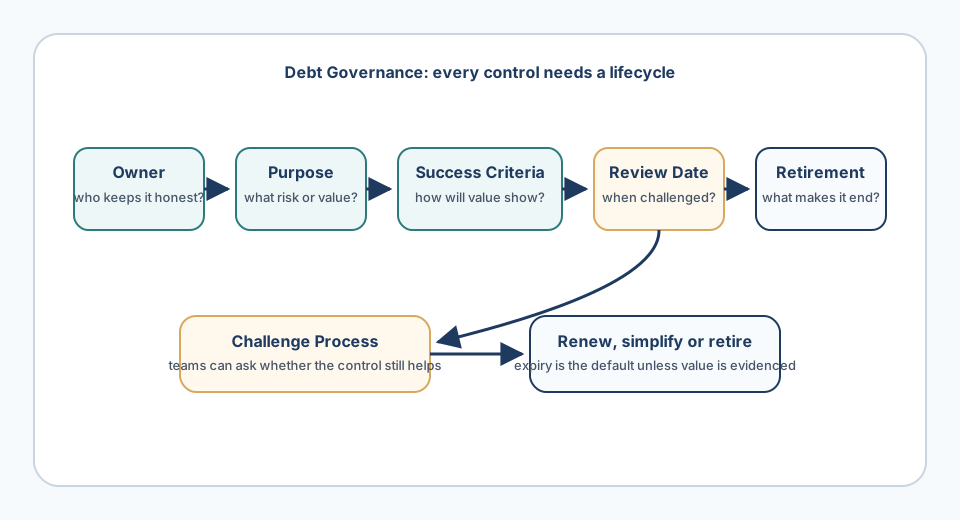
The strongest practical rule is simple: controls should expire unless explicitly renewed. That does not mean removing assurance casually. It means forcing the organisation to demonstrate that the control is still proportionate, effective and worth its operating cost.
11. Enterprise Debt reduction playbook
The quickest improvements usually come from visible friction that nobody loves but everyone tolerates.
| Quick wins | Longer-term improvements |
|---|---|
| Delete reports without named consumers. | Operating model redesign around capabilities and outcomes. |
| Retire unused approvals and duplicate sign-offs. | Governance redesign with clear authority and evidence standards. |
| Merge duplicate governance forums. | Architecture simplification and dependency reduction. |
| Remove duplicate data stores where ownership is clear. | Platform consolidation and data rationalisation. |
| Automate manual controls that still have value. | Control lifecycle management embedded into audit, risk and delivery. |
| Simplify decision paths and publish decision owners. | Capability mapping and transition architecture with retirement gates. |
| Review old policies and remove superseded guidance. | Policy lifecycle management and decision-rights clarification. |
| Identify committees that only share information but make no decisions. | Governance redesign around authority, evidence and escalation. |
A useful 30/60/90 day approach is to inventory the obvious debt, quantify the interest, retire safe items quickly, select a small number of structural debt themes, then create an executive heatmap showing which complexity is worth keeping and which should be actively removed.
13. Conclusion
Complexity is not evidence of maturity. Many organisations mistake accumulated controls for good governance.
The healthiest organisations periodically remove complexity with the same discipline used to remove technical debt. They ask what a control is for, who owns it, what evidence shows it still works, what it costs, what would happen if it disappeared and what simpler mechanism could achieve the same outcome.
Enterprise Debt is not eliminated once. It is continuously managed.
Use this as a review question
If this pattern feels familiar, the practical next step is to identify where complexity is still earning its keep and where the organisation is paying debt interest.
