
Flagship insight
AI Is Forcing Organisations to Rediscover Compartmentalisation
AI is reintroducing a problem mature operational environments have understood for decades: uncontrolled contextual correlation across organisational boundaries creates operational, governance and trust risk.
Opening tension
For years, organisations worked to remove barriers between systems, teams and information domains.
That was often the right instinct. Siloed systems slowed delivery. Isolated teams duplicated work. Fragmented data made decisions harder than they needed to be. Modern platform thinking, product operating models, APIs, data platforms and collaboration tooling all pushed in the same direction: connect more, share more, move faster.
AI is now forcing many organisations to reconsider whether every boundary should have been removed in the first place.
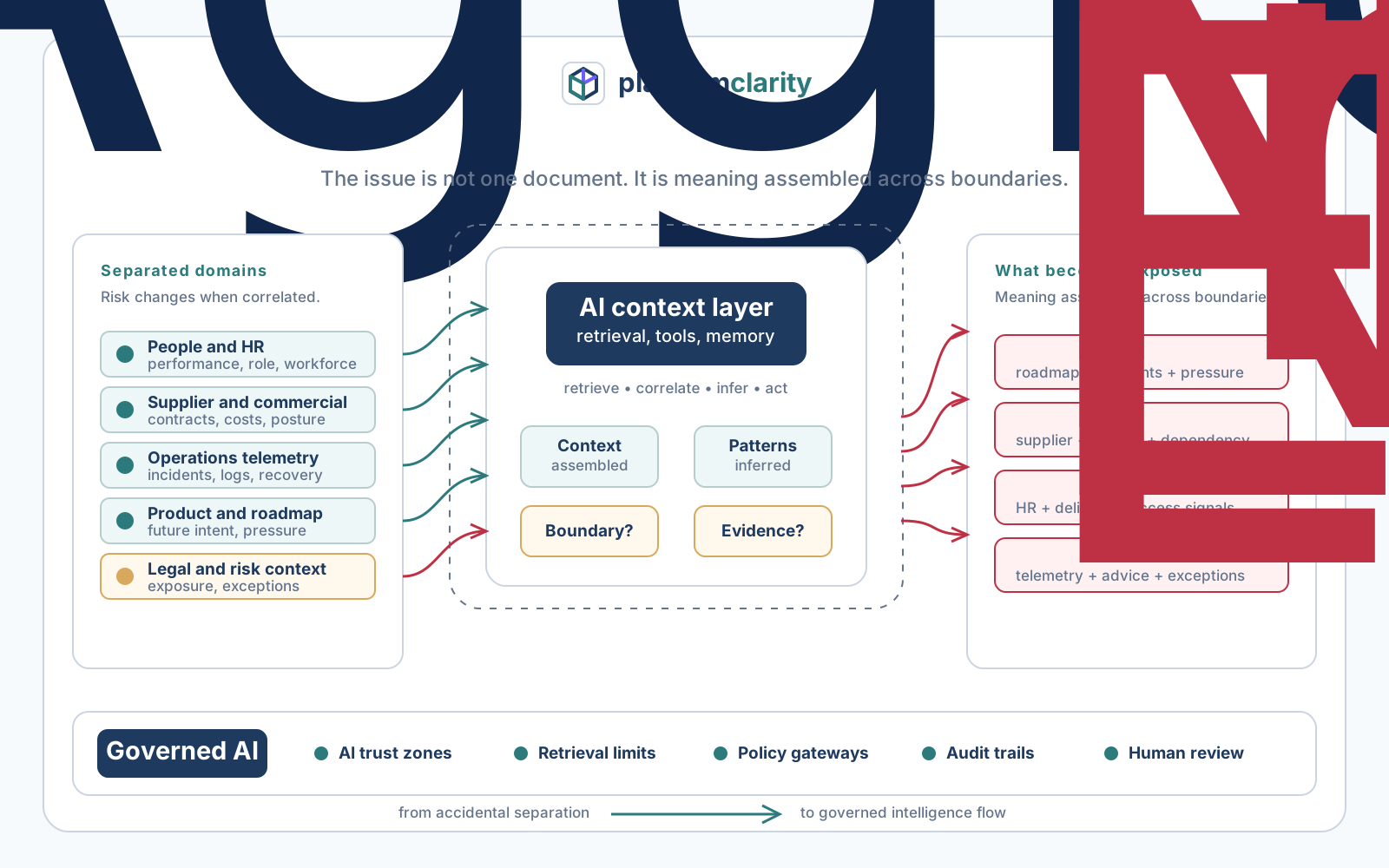
The problem is no longer only whether a person can access a document. The more difficult question is whether intelligent systems can correlate information across domains that were never intended to be connected.
That distinction matters. A traditional access model asks whether a user is permitted to open a file, query a system, or view a record. An AI-enabled operating model asks what meaning can be assembled from many small pieces of permitted context. Individually, each piece may look acceptable. In combination, they can reveal strategy, expose commercial intent, create legal risk, infer employee issues, weaken negotiation position, or collapse a boundary that the organisation relied on without naming it.
This is not an argument against AI. AI is extraordinarily powerful. It can reduce friction, improve discovery, support better decisions and help organisations understand complexity that was previously too slow to inspect. But mature AI adoption depends on architectural discipline. It depends on constrained trust, governed context, observable information flow and operational containment.
The organisations that handle this well will not be the ones that connect everything to everything as quickly as possible. They will be the ones that understand where intelligence is allowed to flow, where it must be constrained, and where confidence is being assumed rather than evidenced.
The article in four lines
AI does not just expose information. It exposes relationships between information.
Compartmentalisation was never primarily about secrecy. It was about survivability.
High-performing organisations optimise for controlled flow rather than unrestricted visibility.
Mature organisations measure trust boundary effectiveness, not just system availability.
We have seen this before
Compartmentalisation is not new. Military organisations, regulated industries, payment environments, safety-critical engineering, privileged infrastructure operations and legal processes have all used versions of it for decades.
The language changes. People talk about need to know, separation of duties, PCI segmentation, privileged access environments, operational segregation, safety zones, classified domains, cross-domain solutions, clean rooms, restricted projects, or controlled interoperability. Underneath the labels is a shared operating principle: do not allow risk, knowledge or authority to spread further than the organisation can understand and contain.
Compartmentalisation was never primarily about secrecy. Secrecy is sometimes one of its effects, but the deeper purpose is survivability. It limits blast radius. It prevents one mistake, one compromised identity, one misunderstood dependency, or one governance failure from becoming a whole-organisation event.
It also protects decision quality. If every domain can see every other domain without context, people can act on partial knowledge. They can optimise locally, draw the wrong inference, or coordinate through informal channels that bypass accountability. A good boundary does not merely hide information. It preserves the conditions under which information can be interpreted safely.
This is why mature operational environments often appear slower from the outside. They have gates. They have roles. They have controlled paths between domains. They require evidence before movement. To immature eyes this can look like bureaucracy. In a high-consequence environment it is often the mechanism that keeps speed from becoming uncontrolled exposure.
The important distinction is between boundaries that create unnecessary friction and boundaries that protect operational flow. Platform Clarity is not interested in defending bureaucracy. But it is very interested in the places where removing friction also removes control, evidence, ownership and recoverability.
AI changes the scale of correlation
Traditional systems expose data. AI systems can expose meaning across datasets.
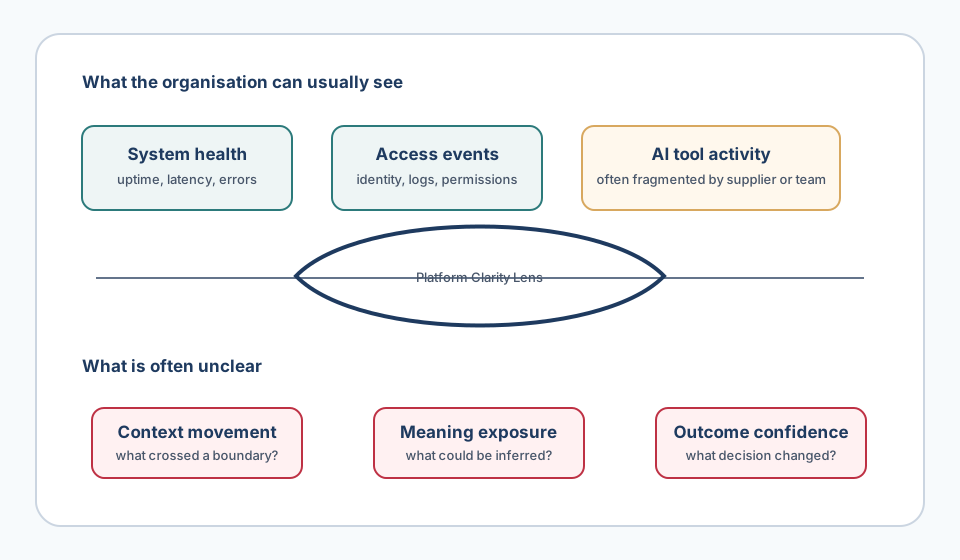
That is the shift many governance models have not yet absorbed. A document repository, CRM, ticketing system or data warehouse may already have access controls. Those controls were usually designed around human lookup and human interpretation. A person searches, reads, compares and decides. Their working memory, time, access path and organisational role naturally constrain what can be correlated.
AI changes those constraints. Retrieval systems can assemble fragments from many sources. Agents can use tools across systems. Summarisation can compress large volumes into a small actionable statement. Embeddings can make relationships discoverable even when the original words do not match. Workflow automation can carry context forward. A model may not expose a raw file, but it may expose an inference that would previously have required privileged cross-domain knowledge.
Operational scenario
The helpful enterprise assistant
Consider a realistic enterprise assistant. It has permitted access to HR records, payroll data, supplier escalations, procurement activity, incident reports, operational telemetry, legal discussions and engineering roadmaps. None of those integrations may look reckless in isolation. Each can be defended as useful: better people analytics, faster supplier response, clearer operational reporting, improved roadmap discovery, more joined-up decision support.
Collectively, the assistant may be able to infer far more than any one access decision intended. It may infer restructuring plans from hiring freezes, manager notes and payroll anomalies. It may infer supplier instability by combining incident volume, procurement tension and legal language. It may infer budget pressure from delayed projects, support deferrals and travel restrictions. It may infer operational weakness from telemetry patterns, known workarounds and unreconciled risk acceptances. It may infer commercial fragility by connecting engineering delays, customer escalations and account planning material.
The problem is not that every source was obviously forbidden. The problem is that the combined context creates new meaning. The risk emerges through correlation, not isolated exposure.
Correlation is now an operating risk
This is the shape of the AI governance problem. A permitted answer can still be an unsafe answer if the organisation never intended those domains to be interpreted together. A low-risk document can become sensitive when combined with another low-risk document. A helpful summary can become a governance event if it collapses a boundary between HR, legal, commercial, operational and engineering judgement.
None of this requires science fiction. These are normal organisational data relationships. AI simply makes them easier to assemble, faster to repeat, and harder to notice if the organisation is only monitoring file access or API calls.
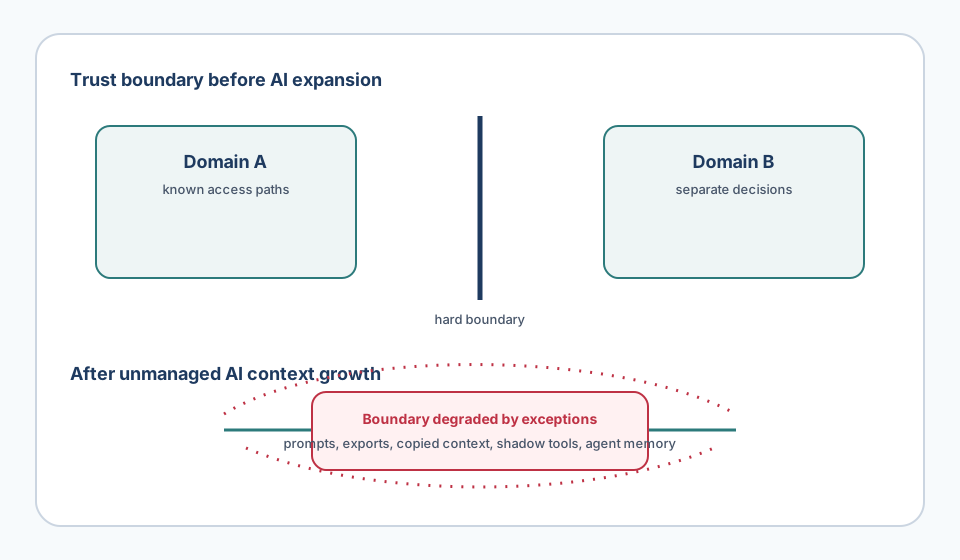
The uncomfortable reality is that many organisations already rely on accidental compartmentalisation. Systems are separated because they were bought at different times. Teams are separated because reporting lines differ. Data is hard to join because schemas are inconsistent. Governance survives partly because correlation is inconvenient.
AI weakens that accidental protection. It makes information more discoverable. That is one of its strengths. It is also why architectural segmentation is becoming relevant again.
Zero Trust was never just about networks
Zero Trust is often flattened into a technology shopping list: identity provider, MFA, device posture, network policy, maybe a secure access proxy. Those things matter, but they are not the point.
The more useful interpretation is constrained implicit trust. Do not assume that a user, workload, device, service, agent or integration should be trusted merely because it is inside a network, inside a tenant, inside a department, or attached to an approved platform.
That principle matters more in AI-enabled environments, not less.
AI agents challenge assumptions about trust because they sit between human intent, system access, interpretation and action. An agent may operate with delegated authority. It may retrieve information on behalf of a user. It may call tools. It may summarise information from multiple systems. It may preserve context between steps. It may create an output that travels further than the source material would have travelled.
A Zero Trust view asks what trust boundary is being crossed, what purpose the access serves, what policy decision allows it, what context is retrieved, transformed or retained, what evidence proves the path was appropriate, and what happens if the agent is wrong, over-broad, compromised or misunderstood.
This is where Zero Trust connects to NIST SP 800-53 Rev. 5 style control thinking, trust boundary design, information classification and operational observability. It is not enough to verify the user at login. The organisation needs to verify and constrain the movement of context, authority and interpretation.
That does not mean every AI interaction needs a heavyweight approval ceremony. It means AI access should be purpose-bound, domain-aware and observable. The correct default is not paranoia. The correct default is explicitness.
High-performing organisations already operate this way
The organisations that do this well are not necessarily slow. Many high-performing organisations optimise for controlled flow rather than unrestricted visibility.
That distinction is central.
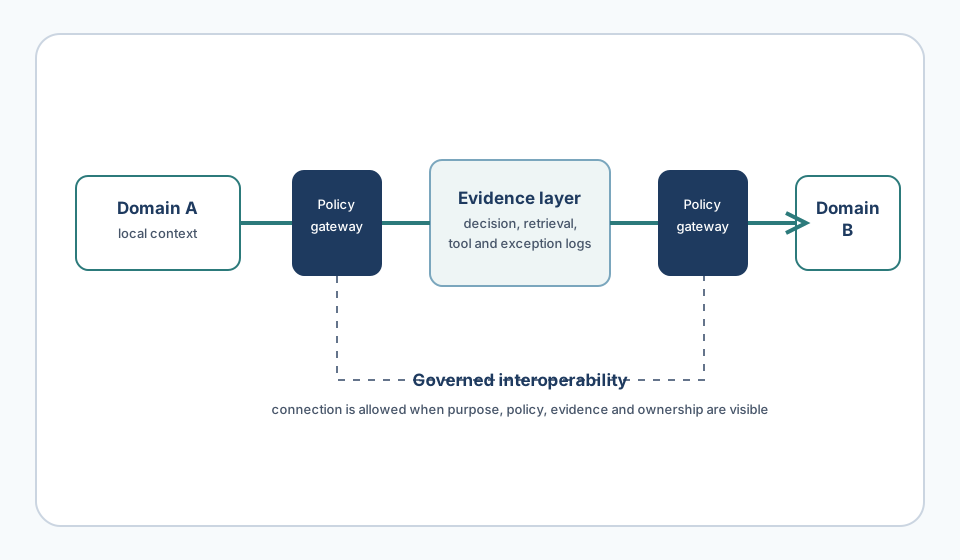
Unrestricted visibility feels efficient until the environment becomes complex enough that information without boundaries creates noise, risk and misinterpretation. Controlled flow is different. It allows information to move through defined paths, with the right context, evidence, ownership and constraints.
DORA is useful here because it changed the conversation about technology performance. It showed that high-performing technology organisations can measure operational flow, delivery stability, recovery and organisational outcomes without reducing engineering to theatre. Lead time, deployment frequency, change failure rate and recovery time are not perfect, but they help make operating reality visible.
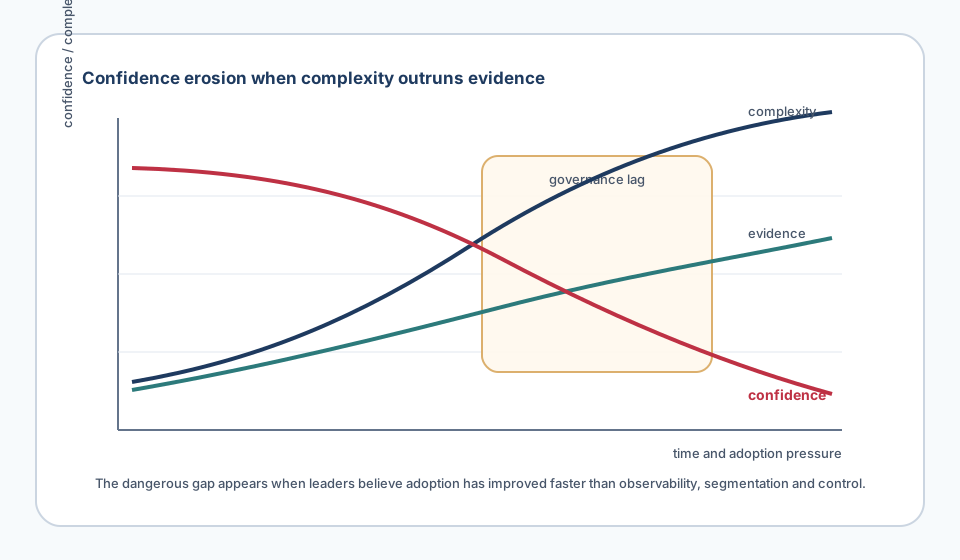
AI governance needs a similar move from principle to measurable operating behaviour. It is not enough to say that AI should be responsible, transparent, secure or human-centred. Mature organisations will need to understand whether contextual integrity is being preserved, whether trust boundaries are working, whether inference remains contained, whether exceptions are growing, and whether governance can keep pace with delivery pressure.
The same logic applies to AI governance. Mature organisations will need to measure flow, friction, resilience and trust boundary effectiveness. They will need to know where approvals queue, where exceptions grow, where policy is bypassed, where retrieval crosses domains, where context is copied manually, where agents fail closed or fail open, and where operational teams lose confidence in what the system is doing.
Regulated industries already understand pieces of this. Aviation safety separates duties and creates evidence trails because failure has consequence. Payment environments segment cardholder data because uncontrolled spread increases blast radius. Military doctrine uses compartmentalisation because uncontrolled knowledge movement can create operational exposure. Engineering governance in high-performance environments often uses disciplined stage gates, design reviews and traceability not to slow delivery, but to make speed survivable.
The lesson is not that every organisation should imitate those regimes literally. The lesson is that speed and control are not opposites when the operating model is mature. Good boundaries make safe speed possible.
AI makes this more important because it increases the rate at which context can move, combine and influence decisions.
The return of architectural segmentation
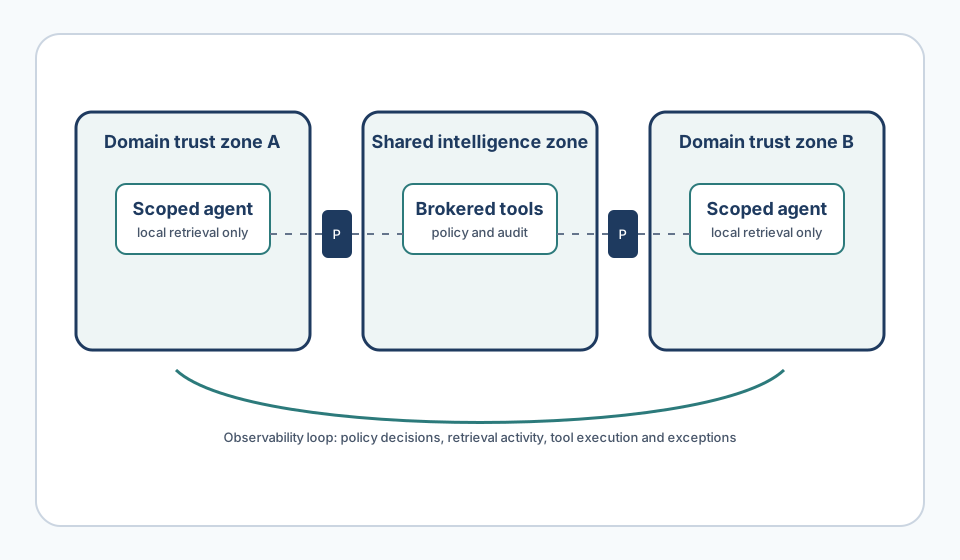
Architectural segmentation is not just network segmentation. In AI-enabled organisations it includes data, identity, tools, prompts, retrieval, models, workflow, audit, ownership and decision rights.
A segmented intelligence architecture might include AI trust zones that define where models, tools and data may interact, retrieval boundaries that prevent broad context aggregation by default, policy gateways that evaluate purpose, role, domain, classification and risk before context moves, and domain-scoped agents that operate within a bounded knowledge area rather than across the whole enterprise.
It may also require segregated knowledge domains where sensitive combinations of information require explicit governance, constrained orchestration so automation cannot silently chain tools across trust boundaries, ephemeral context windows where retained memory is limited, justified and observable, and AI observability layers that record retrieval, tool execution, policy decisions, exceptions and human overrides.
This is where compartmentalisation becomes a modern platform architecture concern. The question is not simply where the model runs. The question is what contextual power the model is given.
Model blast radius is a useful phrase. If an AI capability is wrong, compromised, over-permissioned, poorly prompted or misunderstood, how far can the effect travel? Can it influence one task, one team, one operational domain, one customer journey, one supplier decision, or a whole enterprise workflow?
Inference risk also matters. Some risks do not come from seeing a restricted record. They come from inferring something sensitive by correlating unrestricted records. Information classification schemes that only label individual assets may miss this. The sensitive object may be the relationship between objects.
That is why AI trust zones, compartmentalisation, information classification, observability and architectural segmentation need to be read together. Separately, they look like specialist topics. Together, they describe whether intelligence can move through the organisation without eroding confidence.
Measurable governance and observable signals
Governance that cannot be observed is difficult to trust.
Policy documents are not enough. Architecture boards are not enough. AI principles are not enough. The organisation needs signals that show whether the intended operating model is actually happening during delivery pressure.
Useful signals include access anomalies near trust boundaries, context bleed between domains, retrieval boundary violations, policy bypass frequency, governance queue depth, exception age, dependency density, inference expansion, blast radius growth, audit exceptions, observability gaps, unexplained AI behaviour variance and confidence erosion signals.
The point is not to measure everything. Over-measurement can distort behaviour as badly as under-measurement. The point is to choose signals that reveal whether flow, friction, resilience and trust boundary effectiveness are improving or degrading.
| Signal family | What it reveals |
|---|---|
| Flow signals | Whether AI-enabled work is moving through governed paths or being forced into workarounds. |
| Boundary signals | Whether retrieval, inference, tool use and outputs remain inside intended trust zones. |
| Resilience signals | Whether errors, over-permissioning or model failure can be contained without broad operational impact. |
| Confidence signals | Whether leaders and teams can explain what the AI system used, changed, influenced and escalated. |
This is also where operational governance must avoid becoming theatre. If a control only exists in a policy pack, it will not survive delivery pressure. If a dashboard only counts usage, it will not explain risk. If an approval board cannot see operational evidence, it will become either a bottleneck or a ritual.
A mature AI operating model should be able to answer practical questions quickly: which domains this AI capability can read from, which domains it can write to or influence, which policy decisions were made at runtime, which exceptions were granted, which outputs crossed a boundary, which human decisions relied on AI-generated interpretation, and which signals would show that confidence is eroding.
Those questions are not abstract governance. They are operational survivability questions.
The future architecture question
The future challenge is not whether organisations adopt AI. They will. The pressure is too strong and the potential value is too real.
The harder question is whether they can safely constrain intelligence inside environments that were never designed for continuous machine interpretation.
Many enterprise systems were built for human workflows, role-based access and transaction processing. They were not designed for persistent semantic search across all documents, agentic tool use, automated summarisation, continuous inference or cross-domain orchestration. Retrofitting that world requires more than a policy statement. It requires a renewed architecture of boundaries.
That does not mean returning to isolated silos. It means replacing accidental separation with deliberate compartmentalisation. It means designing controlled interoperability rather than uncontrolled connection. It means making trust boundaries explicit. It means understanding blast radius. It means treating observability as interpretation, not just telemetry. It means governing the movement of context as carefully as the movement of data.
The organisations that get this right will not reject AI. They will use it with more confidence because they can explain where it operates, what it can correlate, what it cannot cross, how exceptions are handled, and what evidence shows the system is behaving as intended.
The organisations that get it wrong may still have impressive demos. They may have high adoption numbers. They may have enthusiastic internal champions. But confidence will erode if nobody can explain how intelligence moves through the operating model.
Working is not the same as resilient.
Connected is not the same as governed.
Visible is not the same as understood.
Mature organisations will not succeed because they deploy the most AI. They will succeed because they understand where intelligence should be constrained, where trust must remain explicit, and where organisational boundaries still matter.
AI is forcing organisations to rediscover compartmentalisation because context has become operationally powerful. The task now is not to rebuild old walls for their own sake. It is to design boundaries that let intelligence flow without allowing confidence, accountability and control to disappear into the gaps between domains.
Use this as a review question
If this pattern feels familiar, the practical next step is to map where AI context can cross boundaries, what evidence exists, and where confidence is being assumed.
